

A few months ago, my current auto policy was coming up for renewal, and the premium shot up by almost 25% for absolutely no reason. No accidents, no tickets, nothing. Naturally, I decided to spend an afternoon shopping around for a better rate.
I hopped onto a popular insurance aggregate site, entered my vehicle details, and typed in my real cell phone number. Within two minutes of hitting “submit,” my phone started buzzing. It wasn’t just a couple of text messages—it was an absolute avalanche of automated spam calls, pushy local agents, and text alerts that did not stop for three solid weeks.
I had accidentally walked right into the lead-generation meat grinder.
Most comparison engines and insurance sites don’t actually want to show you a price instantly on the screen; they want to capture your phone number and sell it to ten different hungry marketing firms.
If you just want to see ballpark numbers to know if you’re getting ripped off—without dealing with non-stop telemarketing calls—there is a right way and a wrong way to do it. Let’s break down exactly how you can extract accurate auto insurance quotes online in 2026 without giving away your real phone number.
The Catch: Why Truly “Anonymous” Quotes Don’t Exist
Before we look at the workarounds, we need to have a quick reality check on how auto insurance underwriting actually works.
You cannot get a 100% anonymous, binding insurance quote using completely fake details. Insurance is a highly regulated financial contract. To give you an exact penny-accurate price, an underwriting algorithm ultimately needs to ping your real driving record, your CLUE report (claims history), and, in most states, your credit tier.
However, there is a massive difference between a binding quote (which you use to actually buy the policy) and a ballpark estimate (which you use to compare market rates).
For the initial comparison stage, you do not need to hand over your personal phone number or your Social Security number to see localized rates. You just need to know how to navigate the fields.
Step-by-Step Playbook to Avoid the Telemarketing Traps
If you want to keep your main phone completely quiet while shopping for coverage, follow this operational blueprint.
Step 1: Use an Anonymous Estimation Calculator First
Instead of going straight to an individual insurance carrier’s checkout page, start with a privacy-focused estimation calculator. Platforms like MoneyGeek, Bankrate, and The Zebra offer data-driven estimate tools directly on their sites.
- How they work: These calculators pull massive historical tables of localized insurance rates based on broad demographics.
- What they ask for: You enter your ZIP code, your age bracket, your credit rating tier (Excellent, Good, Fair), the year/make/model of your vehicle, and whether your driving record is clean.
- The Result: You instantly see an accurate regional average of what carriers like GEICO, Progressive, or State Farm are charging for that exact profile, with zero personal data required.
Step 2: Establish a Digital Privacy Buffer
If you are past the calculator phase and want a more tailored quote from actual insurance platforms, you will inevitably reach a screen that has a little red asterisk (*) next to the phone and email fields. Do not use your primary daily assets here.
- For the Phone Number: Set up a free Google Voice number or use a temporary burner app like Burner or Hushed. Google Voice is entirely free and routes all incoming calls and texts to a separate digital dashboard. You can leave the notifications completely muted while you shop, keeping your actual cell phone dead silent.
- For the Email Address: Create a dedicated, throwaway email account (e.g., myinsuranceshopping2026@gmail.com or a secure Proton mail account). Use this address only for your quote applications. Insurance companies love sending follow-up marketing emails every three days; this keeps that junk completely separated from your actual work or personal inbox.
Step 3: Screen Carriers by Upfront Data Requirements
Not all insurance company quote forms are built the same. Some are incredibly aggressive with data collection, while others are highly flexible.
- The General: In independent privacy testing, The General consistently ranks as one of the least demanding platforms for initial research. Their online flow allows you to move deep into the calculation stage with minimal upfront friction compared to traditional legacy brands.
- GEICO: Their quote system looks complex, but it contains a hidden trick. Many of the fields that look mandatory—such as specific background details or prior policy numbers—can actually be skipped or left blank while still generating a functional quote at the end of the pipeline.
- Progressive: Progressive sits right in the middle. They will prompt you for advanced details like an SSN to pull a hard credit history for a binding rate, but they provide a very clear, clickable “Skip this step” option if you are just browsing through their general market rates.
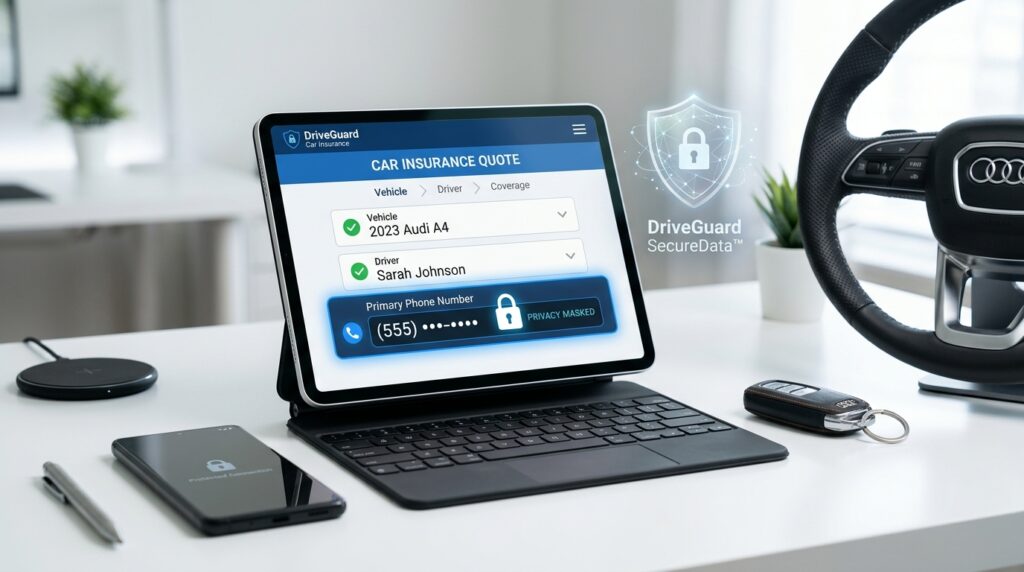
What Information is Safely Required vs. What is Optional?
When filling out these digital forms, knowing what the system actually needs to calculate a real rate versus what it wants for marketing purposes will save your privacy.
| Field Type | What to Input | Why They Need It |
| ZIP Code | Real | Mandatory. Insurance rates are hyper-local. Your garage location dictates your exposure to theft, weather risks, and traffic density. |
| Vehicle Make/Model | Real | Mandatory. A 2024 Honda Civic has vastly different repair costs and safety ratings than a 2015 Ford F-150. |
| Name | Alias / Real | Optional for estimates. You can use initials or a pseudonym during the initial lookup phase if you aren’t ready to buy. |
| Phone Number | Google Voice / Burner | Optional for system function. The system just needs a valid 10-digit format to bypass the form block. A VoIP number works perfectly. |
Costly Mistakes to Avoid When Quote Shopping
- Using Completely Fake Driving Histories: If you have an at-fault accident from two years ago, but you click “Clean Record” just to see a lower price, your estimate is completely useless. The moment you decide to bind that policy, the company will run your official Comprehensive Loss Underwriting Exchange (CLUE) report, and your premium will instantly adjust upward by perhaps 40% or more. Be honest about your record to get a realistic number.
- Forgetting to Opt-Out of Marketing Checkboxes: At the very bottom of almost every single insurance review or summary page, there are tiny, pre-checked boxes that say something like, “I agree to receive automated marketing communications from partners.” Uncheck them all. If you leave them checked, you are legally giving them a waiver to bypass spam registries.
Final Thoughts
The auto insurance market is incredibly volatile right now, and regular comparison shopping is the only realistic way to make sure your current carrier isn’t slowly hiking your rates up under the radar. But you don’t have to sacrifice your personal privacy or turn your phone into a non-stop spam machine just to save a few bucks on your premium.
Spend five minutes setting up a secondary Google Voice number and a clean throwaway email address. Use those shields to run your vehicle details through an anonymous calculator tool or a flexible carrier portal, and analyze the numbers on your own terms. Once you locate the absolute best rate, you can step forward, enter your real legal details, bind the policy, and leave the marketing spam behind.