

When I brought on my first virtual assistant who eventually transitioned into a full-time, W-2 employee, I thought adding them to payroll via Gusto was the only major hurdle. I set up their salary, sorted out the federal withholding tax, and patted myself on the back for becoming a “real” employer.
Exactly three weeks later, I received a certified letter from the state department of labor. It wasn’t an invoice; it was a formal notice of non-compliance. It turns out that the moment my payroll went live with a resident employee in that state, a clock started ticking. Because I hadn’t established a active workers’ compensation policy, I was technically breaking state law every single day that worker clocked in.
I scrambled, paid a stressful compliance penalty, and spent the next 48 hours realizing that when it comes to workers’ comp, the United States is not one country. It is 50 entirely different legal systems.
If you are expanding your team, hiring remote workers across state lines, or shifting from independent contractors to employees, navigating these requirements is vital. Let’s break down how workers’ compensation works across different US states, how to avoid massive state audits, and how to get your team covered without pulling your hair out.
The Golden Rule: Workers’ Comp is State-Regulated
Unlike federal payroll taxes (like FICA), workers’ compensation insurance is governed entirely at the state level. This means there is no central federal agency that tells you who to cover or how much to pay.
Instead, every state sets its own rules based on:
- Employee Thresholds: How many workers you must hire before the insurance becomes legally mandatory.
- Industry Risk: Certain states lower the employee threshold to zero if you operate in high-risk sectors like construction or roofing.
- Sourcing Restrictions: Where you are legally allowed to purchase your insurance coverage.
If you have workers physically sitting in multiple states (even if they are just working from a laptop in their home bedroom), you must comply with the insurance laws of the state where the employee is located, not just where your business is incorporated.
The Four Basic State Categories (The Compliance Landscape)
To make sense of the national compliance map, every U.S. state generally falls into one of four distinct categories regarding small business requirements.
1. Mandatory from Employee #1 (The Vast Majority)
In these states, the moment you hire your very first employee—whether they are full-time, part-time, a minor, or even a family member—you are legally required to carry a workers’ comp policy.
- Key States: California, New York, Illinois, New Jersey, Pennsylvania, Colorado, Ohio, and Indiana.
- The Trap: Do not assume part-time hours shield you. If a college student works for your business for 5 hours a week in California, they must be covered under a valid policy on day one.
2. Mandatory at Three to Five Employees (The Threshold States)
A handful of states give small businesses a bit of breathing room when they are just starting out, setting a minimum employee count before the law kicks in.
- 3+ Employees: Arkansas, Georgia, North Carolina, South Carolina, Virginia.
- 5+ Employees: Alabama, Mississippi, Missouri.
- The Nuance: In states like Missouri or Alabama, the moment you hire your fifth employee, you must immediately secure coverage. Furthermore, executive corporate officers or LLC members often count toward that total employee headcount, even if they aren’t drawing a traditional hourly wage.
3. The Texas Opt-Out (The Sole Maverick)
Texas stands completely alone in the United States. Texas does not require private employers to carry workers’ compensation insurance, regardless of how many employees they have.
- The Reality Check: If you choose not to carry coverage in Texas, you are known as a “non-subscriber.” If an employee gets hurt on the job, they retain the absolute right to sue your business for negligence in civil court, and you lose your standard common-law legal defenses. Most established Texas businesses buy coverage anyway to cap their civil lawsuit exposure.
4. Monopolistic States (The No-Broker Zones)
In 46 states, you can shop around for workers’ comp using private insurance brokers or tech platforms like NEXT, Hartford, or biBERK. However, four states run a strict government monopoly on workers’ comp.
- The Monopolistic States: North Dakota, Ohio, Washington, and Wyoming.
- What this means: You cannot buy a policy from a private commercial carrier for workers in these states. You must set up an account directly with the state’s dedicated insurance fund (for example, the Ohio Bureau of Workers’ Compensation) and pay premiums directly to the state government.
State-by-State Quick Reference Table
Here is a quick look at how requirements, thresholds, and options compare across a selection of major business hubs as of 2026:
| State | Mandate Threshold | Can LLC Members Opt Out? | Where to Buy |
| California | 1+ Employees | Yes, if they own at least 15% of the LLC | Private Brokers or State Fund (State Compensation Insurance Fund) |
| Texas | Not Mandated (Optional) | N/A | Private Commercial Carriers |
| New York | 1+ Employees | Yes, if they are solo owners with no workers | Private Brokers or NY State Insurance Fund (NYSIF) |
| Florida | 4+ Employees (1+ if Construction) | Yes, by filing an explicit online waiver | Private Commercial Carriers |
| Georgia | 3+ Employees | Yes, up to 5 exempt officers/members | Private Commercial Carriers |
| Ohio | 1+ Employees | Yes, for sole proprietors/partners | Monopolistic State Fund Only (Ohio BWC) |
Step-by-Step Guide to Getting Compliant Without Overpaying
If you realize you need to buy a policy today, don’t panic. Following these steps systematically will save you from getting hit with inflated premium costs.
Step 1: Run an Audit of Your Payroll Locations
Look at your team roster. If you use a remote platform like Deel or Remote.com, check the physical addresses of your W-2 team members. Group them by state so you know exactly which state laws you need to satisfy.
Step 2: Leverage Pay-As-You-Go Insurance
Traditional workers’ comp insurance requires you to guess your annual payroll upfront, pay a massive estimated down payment, and then correct it during an painful end-of-year audit.
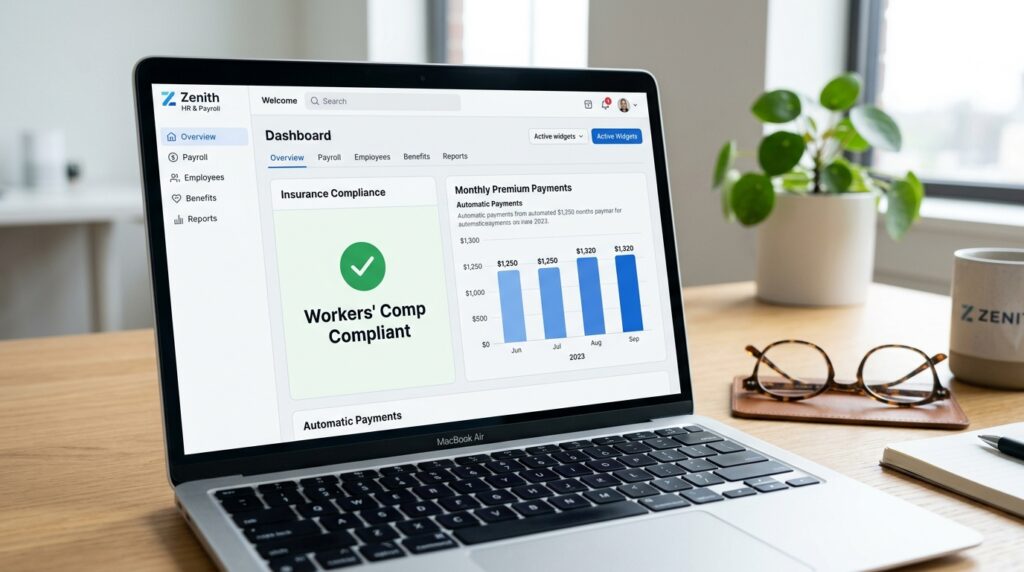
Instead, connect your payroll software (like Gusto or QuickBooks Payroll) directly to a digital insurance partner. This allows you to use Pay-As-You-Go Workers’ Comp. Every time you run payroll, the system calculates the exact premium based on real wages and deducts it automatically. Your upfront down payment drops to near zero, and you avoid surprise audit bills at the end of the year.
Step 3: Classify Your Workers Accurately
Workers’ comp premiums are calculated using NCCI Class Codes (four-digit codes that describe a worker’s job duties).
- An administrative assistant sitting at a desk might have a rate of $0.15 per $100 of payroll.
- A delivery driver or field technician might have a rate of $2.50 per $100 of payroll.
Ensure your workers are categorized perfectly. If you mistakenly classify a remote software developer under a generic “field service” code, your insurance cost will skyrocket unnecessarily.
Expensive Pitfalls to Avoid
- The Independent Contractor Misclassification: Thinking you don’t need workers’ comp because you pay your team via Form 1099. If the state department of labor audits your workflow and determines those contractors operate like employees (e.g., you set their hours, provide their laptops, or manage them closely), they will retroactively reclassify them. You will then be hit with back-premiums and massive misclassification penalties.
- Letting a Policy Lapse: If your business credit card expires and your automatic insurance payment fails, your policy could lapse. States share database networks directly with payroll networks. A single week of a coverage gap can trigger an automatic state fine that often outprices the cost of the actual insurance policy itself.
Keeping Compliance Simple
Dealing with state-by-state employment infrastructure can feel like walking through a regulatory minefield when you just want to focus on building products and driving sales. But spending a quick afternoon auditing your team’s physical locations, understanding your state’s entry thresholds, and hooking up a pay-as-you-go policy removes the risk entirely.
Protecting your team against workplace injuries isn’t just about avoiding a state audit—it’s about building a sustainable business that treats its talent right. Get your infrastructure locked down early, and you won’t have to sweat when a certified letter arrives in your mailbox.