

About a year ago, I was helping a friend audit a custom WooCommerce store she’d spent months building. It was a sleek setup—beautiful product pages, smooth checkout, and a growing list of daily customers buying high-end boutique home goods. Everything looked bulletproof until she woke up one morning to a flood of customer support emails.
Every single email said the same thing: “My credit card company just flagged a fraudulent charge right after I bought from your site.”
A malicious script had been injected through a vulnerability in a third-party shipping calculator plugin. For four days, it silently skimmed customer credit card data and billing addresses right at checkout.
The technical cleanup via security plugins and database rollbacks took about 48 hours. The real nightmare, however, was the financial fallout. She had to hire a forensic IT firm to prove the breach was contained, send out mandatory legal notifications to hundreds of customers across multiple states, and handle the looming threat of compliance fines from credit card networks.
That disaster was my wakeup call. When you run an e-commerce shop, you aren’t just selling products; you are actively holding onto sensitive consumer data. A standard business insurance policy won’t pay a single dollar toward data breaches, ransom demands, or digital business interruption. For that, you need a dedicated Cyber Liability Insurance policy.
Let’s walk through how cyber liability works for small online retailers, what it actually costs, and how to get your store covered without drowning in complex IT jargon.
First-Party vs. Third-Party Cyber Coverage: The Simplified Breakdown
When you start looking at cyber policy documents, insurance brokers love to throw around phrases like “first-party” and “third-party” risks. If you want to keep it simple, think of it as the difference between fixing your own house and paying for damage to your neighbor’s house.
First-Party Coverage (Your Direct Losses)
This is the money required to keep your own business from collapsing immediately after a hack. It covers:
- Forensic IT Investigations: Paying a professional security company to find out how the hacker got into your Shopify or WooCommerce backend and ensuring the exploit is patched.
- Ransomware and Extortion: Covering the costs of crisis negotiators and the actual ransom payment if a hacker locks up your inventory database or customer fulfillment systems.
- Business Interruption Payouts: Replacing your lost net profits for the days or weeks your checkout system is completely offline and unable to process sales.
Third-Party Coverage (The Blame Game)
This kicks in when your angry customers, vendors, or banking networks decide to take legal action against your LLC for failing to protect their data. It covers:
- Legal Defense Fees: Hiring business defense attorneys to fight class-action lawsuits brought by customers whose identities were compromised.
- Regulatory Fines: Covering penalties issued by state agencies or payment processors for PCI-DSS (Payment Card Industry Data Security Standard) non-compliance.
- Credit Monitoring Services: Paying for mandatory one- or two-year credit monitoring subscriptions (like Experian or Equifax) for every affected customer.
Top 4 Cyber Insurance Providers for Small E-Commerce Stores
You don’t need an enterprise-grade corporate policy if you’re running a boutique store from your laptop. These modern, digital-first insurance platforms allow solo founders and small teams to secure solid cyber protection within minutes.
1. NEXT Insurance (Best for Direct Bundling)
NEXT is a fantastic starting point if you want to bundle your cyber coverage directly with your general business liability or product liability insurance.
- The Workflow: They don’t make you fill out a 20-page technical cyber audit. Their online questionnaire asks basic operational questions about your platform and revenue.
- The Advantage: They allow you to add a Cyber Security Insurance Rider onto a standard Business Owner’s Policy (BOP) at a massive discount compared to buying it completely standalone.
2. At-Bay (Best for Active Security Monitoring)
At-Bay is a specialized insurtech company that combines digital insurance coverage with active web vulnerability scanning.
- The Workflow: When you apply for a quote, their automated systems run a non-invasive digital scan of your store’s public domain to check for expired SSL certificates, open ports, or vulnerable email server configurations.
- The Advantage: They don’t just sell you a policy and walk away. They send you active email alerts throughout the year if a new vulnerability is discovered in your specific tech stack, helping you patch the leak before an attack happens.
3. Hiscox (Best for Multi-Platform Retailers)
If you sell across multiple channels simultaneously—such as running a standalone Shopify site, fulfillment through Amazon FBA, and hosting wholesale portals for retail partners—Hiscox provides excellent structural depth.
- The Workflow: Their tech applications cater directly to digital merchants. You can customize your specific limits for data breach response, cyber extortion, and electronic media liability.
- The Advantage: Deep historical underwriting stability. They possess a dedicated, global cyber claims team that moves quickly to assign forensic experts the moment a breach is reported.
4. Coalition (Best for High-Volume and Scaling Stores)
If your online store is clearing mid-six figures in annual revenue and processing thousands of user accounts, Coalition is one of the most comprehensive cyber specialists in the space.
- The Workflow: They provide an advanced, continuous risk management platform alongside their insurance policies.
- The Advantage: Their “Coalition Incident Response” team acts like an emergency digital swat team. If your system experiences a massive data breach or DDoS attack, you have instant access to their internal forensic investigators around the clock to mitigate the damage.
Step-by-Step Guide to Securing a Low Cyber Premium
Insurance underwriters determine your monthly premium based on your store’s security posture. If your site looks like an easy target, your rates will reflect that. Follow this checklist to clean up your digital footprint before applying for a quote:
Step 1: Enforce Mandatory Multi-Factor Authentication (MFA)
This is the absolute number-one question on every single cyber insurance application. If you do not have MFA turned on for your store’s administrator backend (Shopify, WordPress, Magento) and your business email accounts (Google Workspace, Microsoft 365), many underwriters will reject your application instantly. Turn it on today.
Step 2: Use an Off-Site Payment Gateway
Do not collect or store raw credit card numbers directly on your own web servers. Utilize dedicated, secure, third-party payment gateways like Stripe, PayPal, or Shopify Payments. Because these networks handle the tokenization and heavy encryption on their servers, your personal liability profile drops significantly in the eyes of an underwriter.
Step 3: Establish a Plugin and Dependency Update Schedule
Outdated software is the digital equivalent of leaving your front door wide open. Set up a weekly or automated maintenance schedule using tools like Jetpack, Solid Security, or ManageWP to keep your core themes, frameworks, and plugins updated. Tell your broker that you have a formal patch management policy in place.
Small E-Commerce Cyber Premium Estimation Matrix
Here is what the general market numbers look like for standalone small business cyber protection across typical digital retail revenue tiers:
| Annual E-Commerce Revenue | Suggested Policy Limit | Average Monthly Premium | Key Core Inclusions |
| Under $100,000 (Solo Boutique/Side-Hustle) | $250,000 | $25 – $45 / month | Data breach notifications, basic IT forensic discovery, data restoration. |
| $100,000 to $500,000 (Growing Brand) | $500,000 | $50 – $85 / month | Business interruption recovery, PCI-DSS compliance fine protection, extortion coverage. |
| $500,000 to $2M+ (High-Volume Scale) | $1,000,000 | $90 – $160+ / month | Full class-action legal defense, media liability, active continuous vulnerability testing. |
Critical Pitfalls to Watch Out For
- Assuming Your Web Host Handles Your Liability: A massive mistake new shop owners make is thinking, “I host with Shopify or a premium Cloudways setup, so security is their problem.” While premium hosts secure their own core server infrastructure, they are completely insulated from your personal operational errors. If an employee falls for a phishing email, gives away their admin password, or installs a corrupted application extension, the financial liability falls entirely on your business entity.
- Ignoring the “Social Engineering” Exclusions: Standard cyber insurance handles brute-force hacks and server breaches. However, if an employee receives a spoofed email pretending to be your main product supplier and willingly transfers $10,000 to a fraudulent bank account, that is classified as Social Engineering or Funds Transfer Fraud. Look closely at your policy and ensure a social engineering endorsement is added if you manage manual vendor payouts.
Protecting Your Digital Investment
Building a successful independent e-commerce brand takes hundreds of hours of design, product curation, inventory management, and marketing optimization. Leaving all of that progress unprotected against a single malicious plugin vulnerability or automated script attack is a massive gamble.
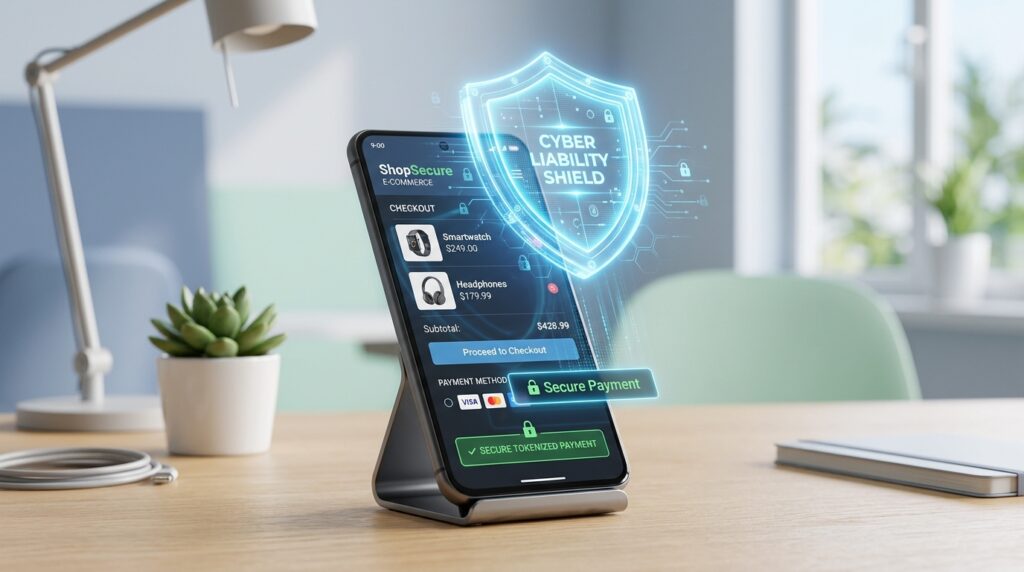
Take an hour this week to lock down your backend systems with multi-factor authentication, check your platform update history, and hop onto a digital carrier portal to review your options. Once you have a active cyber liability shield sitting over your checkout infrastructure, you can watch the daily sales notifications roll in with total, absolute peace of mind.
Quick E-Commerce Cyber FAQs
Does cyber liability cover physical inventory stolen from my garage or warehouse?
No. Cyber liability handles purely digital assets, software systems, data breaches, and network security liabilities. If someone physically breaks into your storage space and steals your physical inventory, boxes, or packing materials, you need to file a claim through a Commercial Property Insurance policy or a Business Owner’s Policy (BOP).
Can I get a cyber policy if my store runs entirely on WordPress/WooCommerce?
Absolutely. While SaaS ecosystems like Shopify are often viewed as slightly lower risk due to closed ecosystems, carriers regularly insure custom WooCommerce installations. You will simply need to confirm that you run a reliable security architecture (such as an enterprise web application firewall like Cloudflare or Sucuri) and keep your core database dependencies updated.
What is the first thing I should do if I suspect my store has been hacked?
Stop, do not delete your site files or try to wipe the site instantly, as this can accidentally destroy critical forensic log data that your insurance company needs to process a claim. Contact your cyber insurance provider’s emergency claims hotline immediately. They will assign a certified forensic analyst to guide you through the containment process while preserving the electronic evidence required to track the source of the breach.