
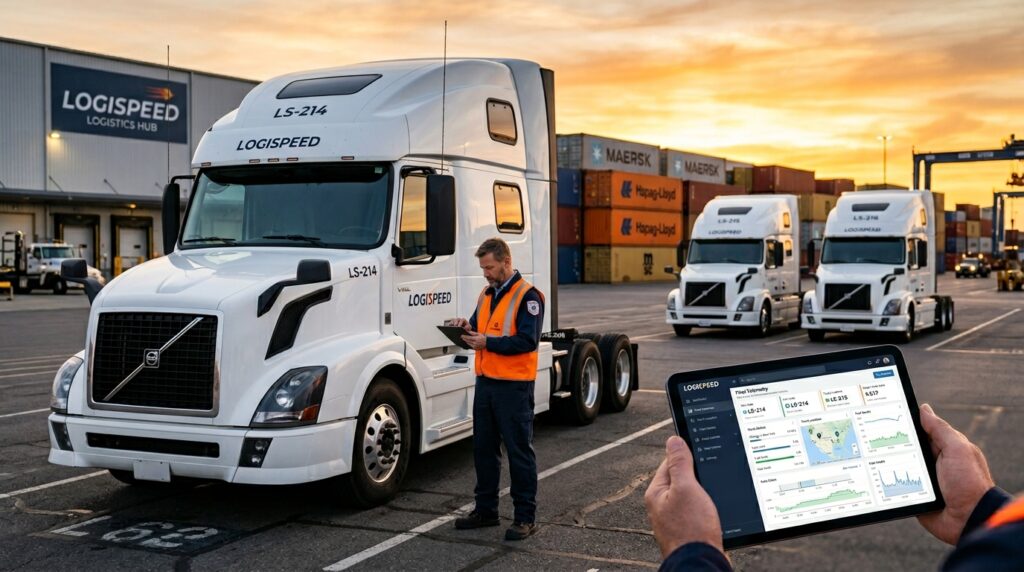
When we launched our first three-truck regional freight setup, we had the trucks lined up, two reliable drivers ready to roll, and a stack of broker contracts waiting for our MC number to go active. We had budgeted for fuel, maintenance, and driver pay down to the penny.
Then came the insurance quotes.
I remember staring at the screen in absolute disbelief. The down payment alone was enough to make my stomach drop, and the annual premium per truck looked more like the price of a luxury SUV. We quickly realized that the “average” numbers you find in a generic Google search don’t apply when you are a brand-new fleet with a fresh DOT number.
If you are stepping into the transportation game this year and trying to figure out what it actually costs to insure a new fleet in 2026, let’s bypass the corporate sales pitches and look at the real numbers, the hidden traps, and how to keep your new business from getting choked out by premiums before you even haul your first load.
The Reality Check: What New Fleets Actually Pay in 2026
If you search for average truck insurance, you will see statistics tossing around numbers like $400 to $600 a month. While that might be true for an established owner-operator leased onto a massive carrier, or a local business running a single box truck, it is a complete myth for a new fleet operating under its own newly minted authority.
In 2026, a brand-new fleet running semi-trucks for interstate general freight should realistically budget $14,000 to $22,000 per year, per truck for their first year of operation.
When you look at that on a monthly operational basis, you are looking at roughly $1,100 to $1,800+ per month per power unit.
Why is it so high? To an insurance underwriter, a new fleet is a ghost. You have no safety data, no inspection history in the cloud, and no historical claims data to prove you aren’t an massive liability risk. You are paying for that lack of data.
Breaking Down the Line Items on Your Insurance Quote
When you get your first major quote packet back from a specialist broker, it won’t be a single flat fee. It will be broken down into specific coverages that brokers, shippers, and the FMCSA (Federal Motor Carrier Safety Administration) legally demand.
1. Primary Auto Liability (The Heavy Lifter)
This is the mandatory coverage required to get your filings active. While the federal baseline minimum under 49 CFR Part 387 is technically $750,000 for general freight, the practical reality of the market is that 99% of freight brokers and shippers will not look at you unless you carry $1,000,000 in Primary Liability. This single coverage accounts for roughly 60% to 70% of your total premium cost.
2. Motor Truck Cargo Insurance
This protects the freight sitting in your trailers. To secure loads on major load boards or get approved with corporate brokers, the industry gold standard is a minimum of $100,000 in Cargo coverage. If you plan on hauling high-value electronics or refrigerated goods (reefer freight), this number will scale up quickly.
3. Physical Damage Insurance
If your fleet equipment is financed or leased—which most new fleets are—your lender will absolutely require Physical Damage coverage. This isn’t based on a flat rate; it’s calculated as a percentage (typically 4% to 6% in 2026) of the Stated Value or Actual Cash Value (ACV) of your rigs and trailers. If you are running brand-new $150,000 tractors, this will add a significant chunk to your bill.
4. General Liability & Excess Policies
Often required for slip-and-fall protection at your terminal or office, or for specific broker packets. Thankfully, this is usually the cheapest part of the puzzle, often running between $500 and $1,500 annually for the whole operation.
The Core Factors Dragging Your Rates Up (or Down)
During our first year, I spent hours trying to figure out why a buddy of mine running a fleet out of Idaho was paying nearly half of what we were being quoted. It turns out, small adjustments in your operational footprint completely change how underwriting algorithms view your risk profile.
Your Garaging ZIP Code & State
Where your trucks sleep matters immensely. If your fleet is registered and garaged in high-litigation, high-traffic states like New York, Florida, Louisiana, or California, you will face rates that are 40% to 100% higher than a fleet operating out of low-density states like Maine, Idaho, or Iowa.
| State Tier | Estimated Monthly Cost Per Semi (New Authority) |
| High Cost (NY, FL, LA, CA) | $1,500 – $2,200+ / month |
| Average Cost (TX, IL, GA, PA) | $1,100 – $1,600 / month |
| Low Cost (ME, ID, VT, ND) | $750 – $1,100 / month |
Operating Radius
Are your drivers staying local (within a 100-mile radius), regional (regional tri-state area), or going fully long-haul coast-to-coast? The moment your trucks enter the “Unlimited OTR (Over-the-Road)” category, your risk exposure multiplies because of driver fatigue, highway speeds, and varied weather patterns. Keeping your radius restricted on paper to a regional footprint can instantly shave thousands off your initial quote.

Cargo Classification
What you haul dictates your risk level. General dry van freight is the benchmark baseline. If your new fleet is jumping straight into HAZMAT cargo, heavy-haul flatbeds, or fuel tankers, your insurance premium can instantly double, frequently pushing past $25,000 a year per truck because the severity of a potential accident is so catastrophic.
The Down Payment Trap: Cash Flow Survival Strategy
Here is a costly mistake we made that nearly broke our operational cash flow in month one: expecting to pay a simple, low monthly insurance premium right out of the gate.
Most traditional commercial auto providers do not offer standard monthly financing directly to a brand-new trucking authority. Instead, your broker will set you up with a premium finance company. They pay the full annual premium to the insurance company upfront, and you pay them back over 9 or 10 installments.
Because you are a new venture, these premium finance companies almost always demand a 20% to 25% down payment at binding.
⚠️ Cash Flow Reality Check: If your total annual premium for a small 3-truck fleet comes out to $48,000, you will need to hand over $9,600 to $12,000 in cash on day one just to get your insurance filings submitted to the FMCSA. You must keep this capital separate from your equipment down payments and initial fuel reserves.
Actionable Levers to Lower Your Fleet Insurance Costs
You don’t just have to sit back and take whatever high quote a broker throws at you. There are a few highly practical levers you can pull to actively force those first-year numbers down.
- Enforce Strict Commercial Driver’s License (CDL) Standards: Do not hire drivers with less than 2 years of verifiable clean CDL experience, or anyone under the age of 23. If an insurance underwriter sees a 21-year-old driver with 6 months of experience on a new authority application, they will either reject the quote entirely or price it out of existence.
- Invest in Telematics and Dashcams Instantly: In 2026, forward-facing and driver-facing dashcams combined with an ELD (Electronic Logging Device) system like Motive or Samsara are powerful underwriting tools. Tell your broker you have mandatory speed governors set to 65 MPH and inward/outward cameras installed. Several major insurance providers offer an immediate 5% to 15% credit just for adopting this tech.
- Opt for Higher Deductibles (Safely): Moving your Physical Damage or Cargo deductible from $1,000 to $2,500 or $5,000 shifts some of the minor risk onto your business shoulders. This tells the underwriter you aren’t going to file a claim for every minor scratch or dent, which drops your annual premium significantly. Just make sure you maintain a cash reserve to cover that deductible if a real incident occurs.
- Pay the Annual Premium In Full If Capital Permits: If you have access to a business line of credit or partner capital, paying the full 12-month premium upfront eliminates premium finance company interest rates, instantly saving you anywhere from 7% to 12% on the total cost of the policy.
Moving Into Year Two
The absolute best news about commercial truck insurance is that the first year is always the hardest. If you can manage your operational cash flow through those first 12 months, keep your SMS/BASIC scores clean in the FMCSA system, avoid accidents, and pass your New Entrant Safety Audit, your rates will shift dramatically.
When your policy comes up for its first major renewal in Year Two, you will suddenly have access to double the number of insurance markets. It is incredibly common to see a 30% to 40% reduction in premiums the moment you transition from a “new venture” to an “established fleet with a proven safety record.”
Treat your insurance premium as an operational score to beat. Drive safe, leverage tech, keep your files clean, and you’ll get those numbers down to a highly profitable baseline.