
Have you ever wondered how your computer, which is made of plastic and metal, actually “thinks”? Or how a burglar alarm knows exactly when to ring? It all comes down to two simple numbers: 0 and 1.
Welcome to Chapter 7 (Basic Electronics). Honestly, when I was in school, I found this chapter the easiest and most scoring. Why? Because there are no long derivations or complex calculations here—just simple logic!
In this guide, I will take you from the “Boiling Electrons” (Thermionic Emission) to the “Brain of the Computer” (Logic Gates). By the end of this post, Truth Tables will look as easy as ABC to you.
1. Thermionic Emission (Boiling Electrons)
Let’s start with a simple question: What happens when you boil water? Steam comes out, right? Similarly, when you heat a metal filament to a very high temperature, Electrons start “jumping” out of its surface.
This process of emitting electrons from a hot metal surface is called Thermionic Emission. (Think of it as “Thermal” = Heat, “Ion” = Charged Particle).
Where is it used? This is the principle used in X-Ray machines and those old, big boxy TVs (CRT) that we used to watch cartoons on.
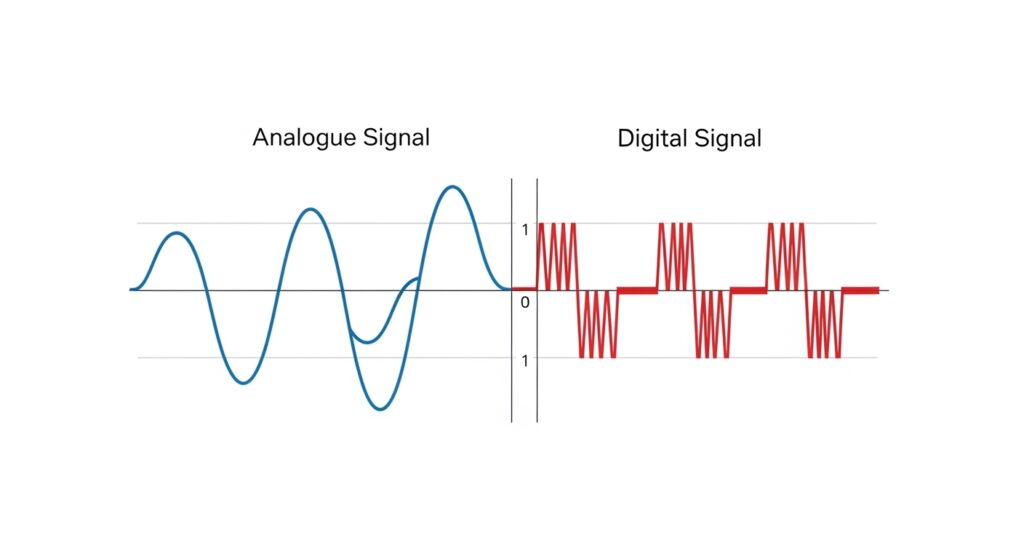
2. Analogue vs. Digital Electronics (The Two Worlds)
I have seen students get confused between these two. Let me give you a Real-Life Example.
- Analogue Quantity: Think of a Ramp. You can stand at any height continuously.
- Examples: Temperature, Time, Sound (These change continuously).
- Digital Quantity: Think of a Staircase. You can stand on step 1 or step 2, but you cannot stand “in between.”
- Examples: Switches (On/Off), Computers (0/1).
Why do computers use Digital? Because it is accurate. There is no “maybe.” It is either YES (1) or NO (0).
3. Basic Logic Gates (The Decision Makers)
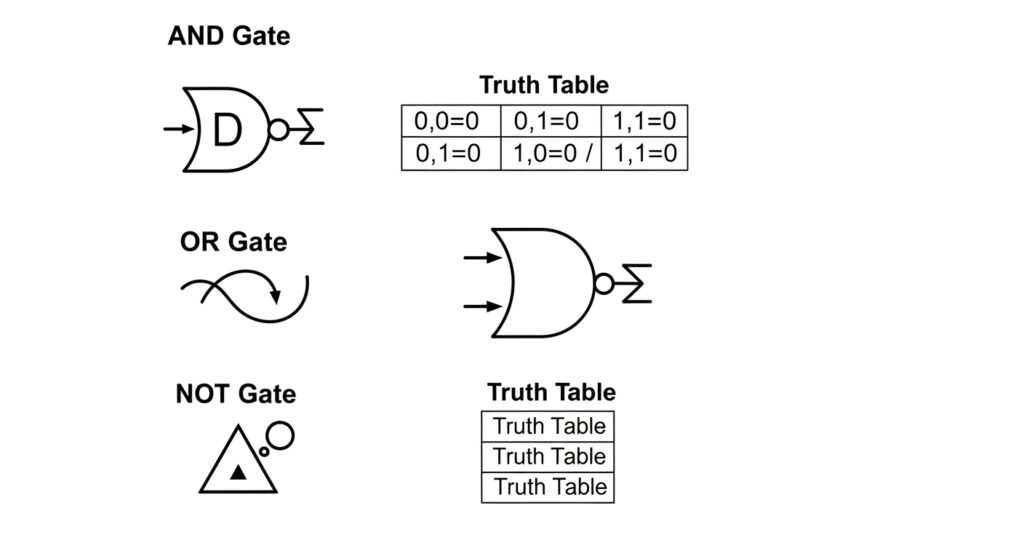
This is the heart of this chapter. A Logic Gate is a digital circuit that makes decisions based on certain rules.
Let’s decode the three main gates.
A. AND Gate (The Strict Gate)
Think of this as a strict parent. It says “YES” only if BOTH conditions are met.
- Symbol: D-shaped.
- Logic: Output is 1 only if Input A AND Input B are 1.
- Formula: $X = A \cdot B$ (Read as A dot B).
- Real Life Example: A safe with two keys. It opens only if Key A AND Key B are used together.
B. OR Gate (The Friendly Gate)
This is a lenient gate. It says “YES” if ANY one condition is met.
- Symbol: Curved shape.
- Logic: Output is 1 if Input A OR Input B (or both) are 1.
- Formula: $X = A + B$.
- Real Life Example: A doorbell. The bell rings if you press the Front Door button OR the Back Door button.
C. NOT Gate (The Rebel)
This gate is an “Inverter.” It always does the opposite.
- Logic: If you give it 1 (High), it gives 0 (Low). If you give 0, it gives 1.
- Formula: $X = \bar{A}$ (Read as A bar).
- Real Life Example: The light inside your fridge. When you CLOSE the door (1), the light goes OFF (0).
4. Truth Tables (The Cheat Sheet)
A Truth Table is simply a chart that shows all possible inputs and outputs. Don’t memorize them! Just use the logic I explained above.
- AND Gate: Look for “0”. If any input is 0, the answer is 0.
- OR Gate: Look for “1”. If any input is 1, the answer is 1.
5. CRO (Cathode Ray Oscilloscope)
The CRO is like a “Doctor’s Stethoscope” for electronics engineers. It draws a graph of voltage versus time on a screen
Main Parts:
- Electron Gun: Shoots electrons.
- Deflecting Plates: Moves the beam Up/Down (Y-plates) and Left/Right (X-plates).
- Fluorescent Screen: Glows when electrons hit it.
Important Short Questions (2025 Syllabus)
Q1: What is the difference between Analogue and Digital quantities?
Ans:
- Analogue: Quantities that vary continuously (e.g., Temperature, Voltage).
- Digital: Quantities that vary in discrete steps (0 and 1).
Q2: Write the Boolean expression and Truth Table for a NAND Gate.
Ans: NAND is the opposite of AND.
Formula: $X = \overline{A \cdot B}$.
It gives ‘0’ only when both inputs are ‘1’.
Q3: What is the use of an Electron Gun in a CRO?
Ans: The electron gun generates, accelerates, and focuses a narrow beam of electrons onto the screen to create a visible spot.
Chapter Summary (Quick Recap)
- Thermionic Emission: Release of electrons from hot metal.
- AND Gate: Multiplication ($A \cdot B$). Needs both High.
- OR Gate: Addition ($A + B$). Needs at least one High.
- NOT Gate: Inversion ($\bar{A}$). Reverses the input.
- CRO: Displays voltage waveforms.
FAQs: Students Also Ask
Q: Why do we use binary (0 and 1) in computers?
Ans: Because electronic circuits are made of switches (Transistors). A switch has only two stable states: ON (1) and OFF (0). It is reliable and minimizes errors.
Q: Can we make a NAND gate using Basic Gates?
Ans: Yes! If you connect a NOT Gate at the output of an AND Gate, it becomes a NAND Gate. That is why NAND is called a “Universal Gate.”
Q: Is this chapter important for Long Questions?
Ans: Yes. The “NAND Gate as a Burglar Alarm” or “Operation of CRO” are very popular Long Questions in Board Exams.
Final Advice
Electronics is the future. Don’t just read this chapter to pass the exam; try to understand the logic.
My suggestion: Draw the symbols of AND, OR, and NOT gates on a piece of paper 5 times. If you mix up the symbols in the exam, your whole Truth Table will be marked wrong!
Next up is Chapter 8 (Information & Communication Technology). Ready to learn about the Internet and Radio?