
Have you ever wondered how a simple piece of wire inside a fan makes it spin at such high speed? Or how a huge power station sends electricity to your home, but your mobile charger uses only a tiny bit of it?
It feels like magic, but it is actually Electromagnetism.
When I was in 10th grade, this chapter gave me nightmares. I always got confused: “When do I use the Right Hand Rule and when do I use Fleming’s Left Hand Rule?” If you are facing the same problem, relax. Today, I will decode the secrets of Motors, Generators, and Transformers in plain English. No boring definitions, just pure logic.
1. Magnetic Effect of Current (The Accident)
Did you know that electricity and magnetism are actually best friends? In 1820, a scientist named Hans Christian Oersted accidentally discovered that when current flows through a wire, a compass needle nearby starts moving.
Conclusion: Current-carrying wires behave like magnets.
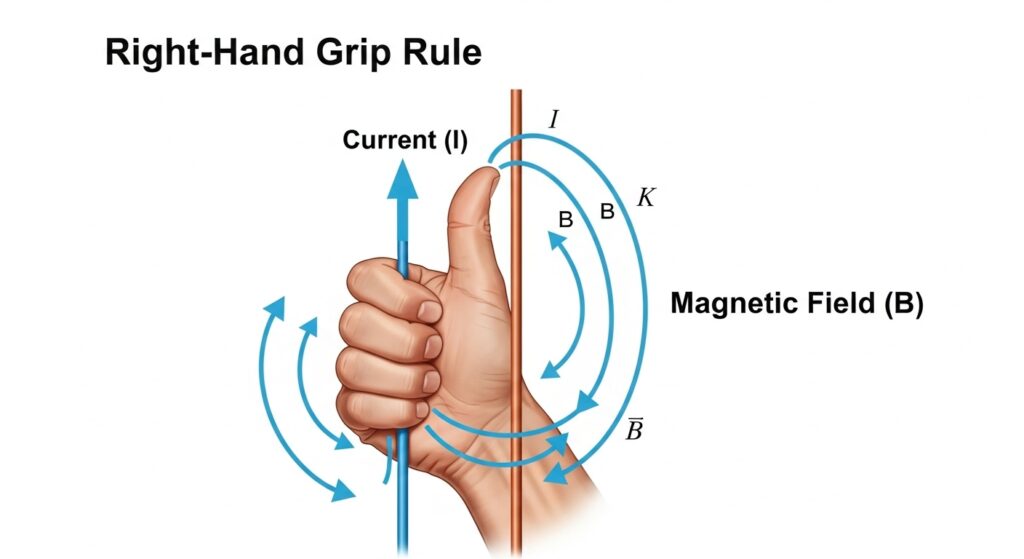
The Right-Hand Grip Rule (Don’t confuse this!): To find the direction of the magnetic field:
- Imagine gripping the wire with your right hand.
- Thumb = Direction of Current.
- Curled Fingers = Direction of Magnetic Field.
2. Force on a Current-Carrying Conductor ( The Motor Principle)
Now, here is a cool thought experiment. We know a current-carrying wire is basically a magnet. What happens if we place this “Wire Magnet” inside a “Permanent Magnet”? Boom! They will push or pull each other. This is the force that runs every motor in the world.
Fleming’s Left-Hand Rule (The FBI Trick): To find the direction of the force, stretch your left hand:
- Thumb = Thrust (Force)
- Forefinger = Field (Magnetic Field)
- Center finger = Current (Remember it as FBI: Force, B-Field, I-Current).
3. The DC Motor (Turning Energy into Motion)
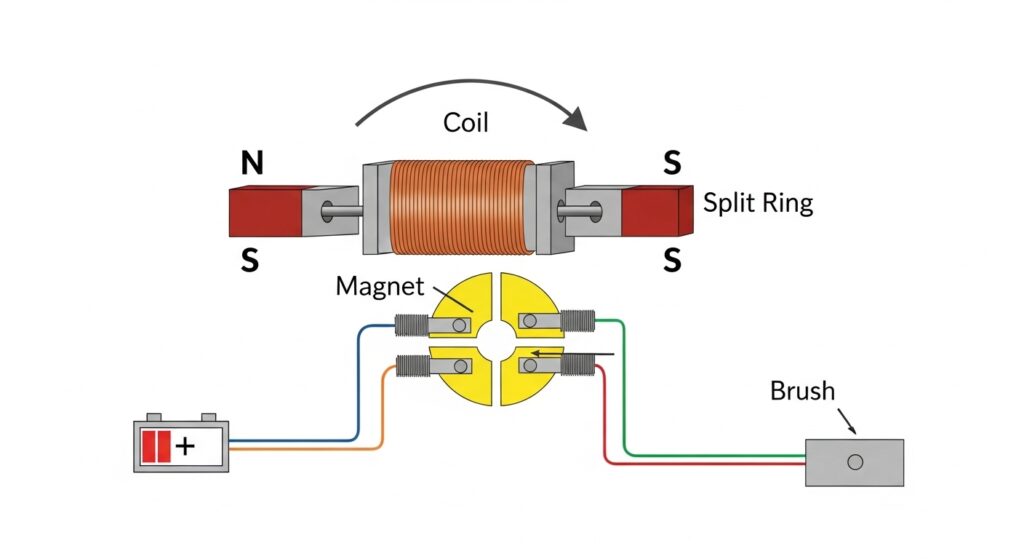
This is a favorite topic for Long Questions. A DC motor converts Electrical Energy into Mechanical Energy.
How does it spin? When current flows through the coil, one side gets pushed up and the other gets pushed down (due to magnetic force). This creates a Torque, and the coil starts rotating.
The Secret Hero: Split Ring Commutator I used to wonder, “Why doesn’t the wire twist and break?” The Split Ring is a clever device that reverses the direction of current every half rotation, keeping the motor spinning in one direction smoothly.
4. Electromagnetic Induction (Generating Electricity)
If electricity can produce magnetism, can magnetism produce electricity?
Michael Faraday said “Yes!”
If you move a magnet inside a coil of wire, current starts flowing in the wire. You don’t need a battery; you just need Motion. This is called Electromagnetic Induction.
Lenz’s Law (Nature Hates Change):
This is a tricky concept. Lenz’s Law states that the induced current always opposes the cause that produced it.
- Real Life Example: It’s like a stubborn child. If you push the magnet in, the coil tries to push it out. If you pull the magnet out, the coil tries to pull it back.
5. The Transformer (The Voltage Changer)
How does your mobile charger convert the dangerous 220V from the socket into a safe 5V for your phone? It uses a Transformer.
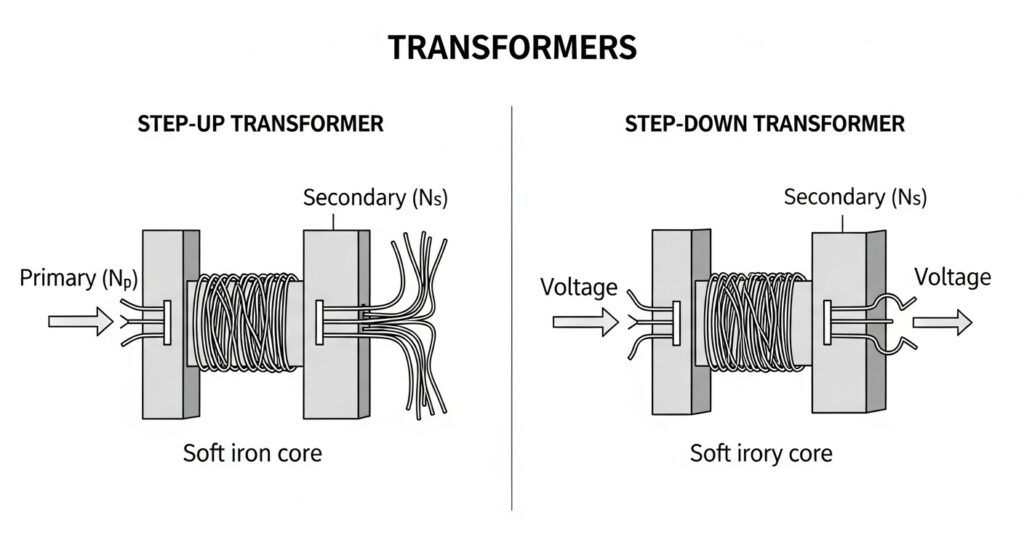
Principle: Mutual Induction (Two coils placed near each other).
Types of Transformers:
- Step-Up Transformer: Increases voltage ($N_s > N_p$). Used at power stations.
- Step-Down Transformer: Decreases voltage ($N_s < N_p$). Used in chargers and home supplies.
The Golden Formula:
$$\frac{V_s}{V_p} = \frac{N_s}{N_p}$$
(Where $V$ is Voltage and $N$ is the number of turns in the coil).
Important Short Questions (2025 Syllabus)
Examiners love asking these technical questions:
Q1: What is the function of the Split Ring Commutator in a DC Motor?
Ans: It acts as a reversing switch. It reverses the direction of current in the coil every half rotation to keep the motor rotating continuously in the same direction.
Q2: Why is the core of a transformer made of soft iron?
Ans: Soft iron is a ferromagnetic material. It increases the magnetic flux and reduces energy loss (Hysteresis loss), making the transformer more efficient.
Q3: State Lenz’s Law.
Ans: The direction of the induced current is always such that it opposes the change in magnetic flux that produced it. (It is based on the Law of Conservation of Energy).
Chapter Summary (Quick Recap)
- Oersted’s Experiment: Current creates a magnetic field.
- Motor Effect: Electrical Energy $\rightarrow$ Mechanical Energy.
- Generator Effect: Mechanical Energy $\rightarrow$ Electrical Energy.
- Transformer: Changes Voltage levels (only works on AC).
- Step-Up: Increase Voltage.
- Step-Down: Decreases Voltage.
FAQs: Students Also Ask
Q: Can a transformer work on DC (Direct Current)?
Ans: No! A transformer needs a changing magnetic flux to work. DC provides a constant current, so no induction takes place. If you connect a transformer to a DC battery, the coil might burn!
Q: What is the difference between a Generator and a Motor?
Ans: Structurally, they are very similar. But functionally:
- Motor: You give electricity, it gives motion (Fan).
- Generator: You give motion, it gives electricity (Power Plant).
Q: Which rule is used for Motors?
Ans: Fleming’s Left-Hand Rule is used for Motors. (Remember: Mother Love = Motor Left).
Final Advice
This chapter is “Dry” if you just memorize it, but “Easy” if you visualize it.
Focus on the Transformer Numerical Problems (using the $V_s/V_p = N_s/N_p$ formula). They are very easy marks—just simple division and multiplication!
Next up is Chapter 7 (Basic Electronics). Do you want to know how Logic Gates work? Let me know in the comments!