
Imagine your life without your smartphone, or imagine a summer afternoon without a fan. Impossible, right?
We are surrounded by wires, switches, and batteries, yet most of us don’t know how they actually work.
In Physics Chapter 5 (Current Electricity), many students get a headache trying to understand why Series circuits divide voltage but Parallel circuits don’t. I have seen students memorizing Ohm’s Law without knowing what “Resistance” actually feels like.
Don’t worry. Today, I will take you inside the wire. We will understand how electrons flow, how to calculate your electricity bill, and how to score full marks in numericals.
1. What is Electric Current? (The River of Electrons)
Think of a copper wire as a pipe and Current as the water flowing through it.
- Definition: The rate of flow of electric charge through a conductor is called Electric Current.
- Formula: $I = Q / t$
- Unit: Ampere (A).
The Great Confusion: Conventional vs. Electronic Current
When scientists first discovered current, they thought positive charges moved. So, they said current flows from Positive (+) to Negative (-). This is called Conventional Current.
Later, we found out that actually, electrons move from Negative (-) to Positive (+) (Electronic Current).
- Pro Tip: In exams and circuit diagrams, we always follow the Conventional Current (Positive to Negative) tradition.
2. Ohm’s Law (The King of Formulas)
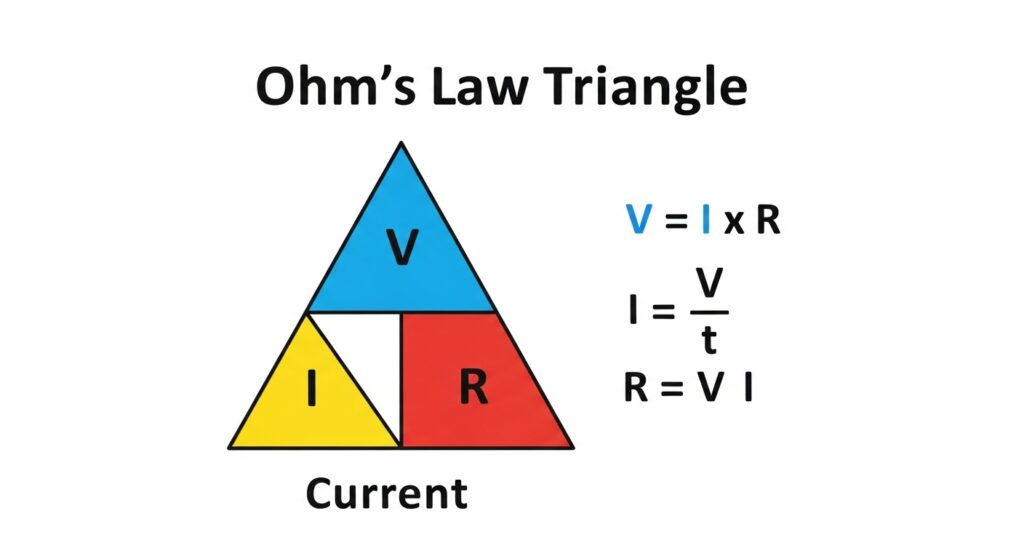
If there is one formula you must tattoo on your brain for Physics Class 10, it is this one.
George Simon Ohm discovered a relationship between Voltage (V) and Current (I).
Statement:
The current flowing through a conductor is directly proportional to the potential difference across its ends (provided the temperature remains constant).
Formula:
$$V = I R$$
(Where ‘R’ is Resistance).
3. Resistance: The Speed Breaker
Why doesn’t the battery empty in 1 second? Because of Resistance.
Resistance is the opposition offered by the wire to the flow of current. Think of it as a “Traffic Jam” for electrons.
Factors Affecting Resistance:
- Length: Longer wire = More resistance (More collisions).
- Thickness (Area): Thicker wire = Less resistance (More space to move).
Real-Life Example:
Imagine a wide highway (Thick Wire) vs. a narrow street (Thin Wire). Traffic moves faster on the highway. Similarly, current flows easily through a thick wire.
4. Series vs. Parallel Circuits (Where Students Lose Marks)
This is the most critical part of the chapter. Please pay attention!
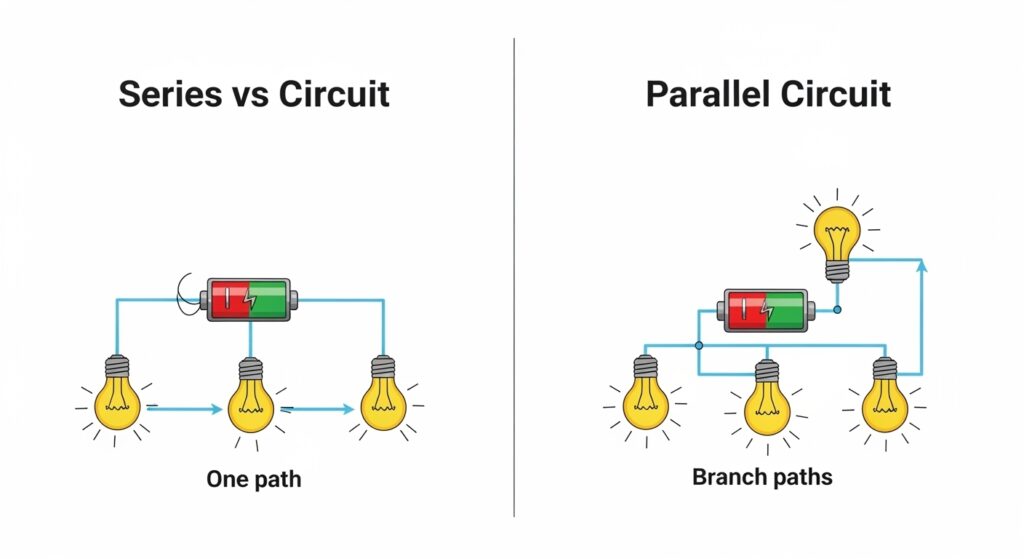
A. Series Combination (The “Old Fairy Lights” Style)
- Connection: Resistors are connected end-to-end in a single path.
- The Problem: If one bulb fuses, the whole circuit breaks.
- Rule: Current is the SAME, Voltage divides.
- Formula: $R_{eq} = R_1 + R_2 + R_3$
B. Parallel Combination (Our House Wiring)
- Connection: Resistors are connected across the same two points.
- The Benefit: If one bulb fuses, the others keep glowing. That is why our houses are wired in parallel!
- Rule: Voltage is the SAME, Current divides.
- Formula: $\frac{1}{R_{eq}} = \frac{1}{R_1} + \frac{1}{R_2} + \frac{1}{R_3}$
5. Electric Power & Joule’s Law (Calculating the Bill)
Have you ever noticed that your mobile charger gets hot while charging?
This is Joule’s Law. When current flows through a resistance, it generates heat.
$$W = I^2 R t$$
How to Calculate Electricity Bill?
The electricity meter outside your house counts “Units”.
- 1 Unit = 1 kWh (Kilowatt-Hour).
- Formula: $\text{Cost} = \frac{\text{Watt} \times \text{Hours}}{1000} \times \text{Rate per Unit}$.
6. Electrical Safety (Don’t Get Shocked!)
Safety is crucial when dealing with electricity.
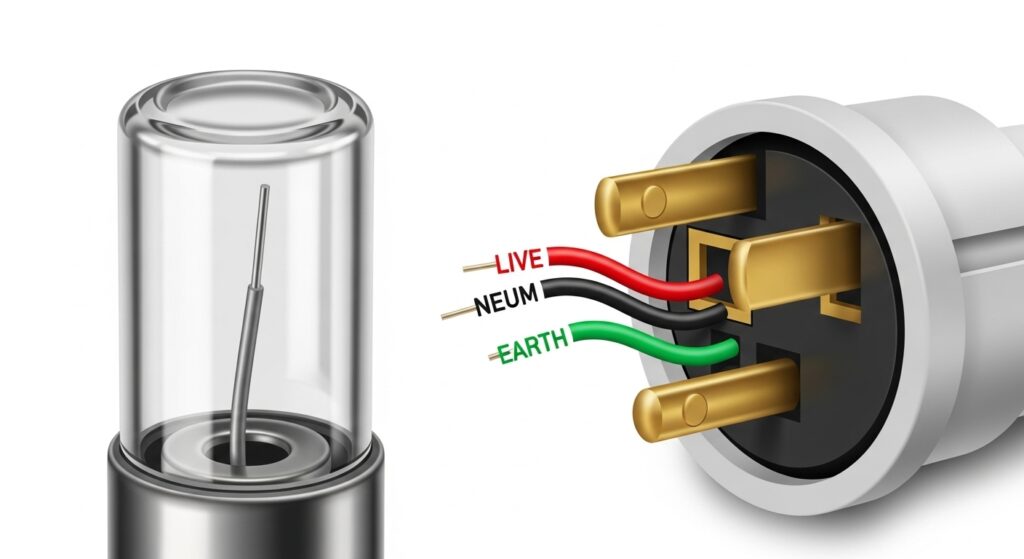
- Fuse: A thin wire that melts and breaks the circuit if the current gets too high (protecting your expensive TV).
- Circuit Breaker (MCB): A modern switch that automatically turns off during a fault.
- Earth Wire: An extra wire connected to the ground to save you from electric shocks if the appliance leaks current.
Important Short Questions (2025 Syllabus)
Here are the questions frequently asked in Board Exams:
Q1: Define Ohm’s Law and its limitations.
Ans: Current is directly proportional to Voltage ($V=IR$), provided the physical state (temperature) of the conductor remains constant. It is not applicable to semiconductors (like diodes).
Q2: Why is household wiring done in parallel?
Ans:
- Each appliance gets the full voltage (220V).
- Each appliance can be turned on/off independently.
- If one appliance fails, others continue to work.
Q3: What is the difference between a Fuse and a Circuit Breaker?
Ans: A Fuse works once (melts and needs replacement). A Circuit Breaker is a switch that just trips (can be reset and reused).
Chapter Summary (Quick Recap)
- Current ($I$): Rate of flow of charges (Unit: Ampere).
- Ohm’s Law: $V = IR$.
- Resistance: Opposes flow. Depends on length and area.
- Series: $R_{eq} = R_1 + R_2$ (Current same).
- Parallel: $1/R_{eq} = 1/R_1 + 1/R_2$ (Voltage same).
- Power: $P = VI$ or $P = I^2R$.
FAQs: Students Also Ask
Q: Does a thick wire have more resistance or a thin wire?
Ans: A thin wire has more resistance because electrons have less space to move. A thick wire has less resistance.
Q: Can we use a copper wire instead of a fuse?
Ans: NEVER! Copper has a high melting point. If current exceeds the limit, the copper wire won’t melt, and your appliance might catch fire. Always use a proper fuse wire.
Q: Which numericals are important in Chapter 5?
Ans: Focus on finding the Equivalent Resistance ($R_{eq}$) in mixed circuits and calculating the Electricity Bill (Cost of electricity).
Final Advice
Physics is not about memorizing lines; it’s about understanding how the world works. Next time you switch on a light, think: “Is this switch in series with the bulb?” (Yes, it is!).
Practice the circuit diagrams (Series/Parallel) at least twice. If you can solve the circuit diagram, you have won half the battle.
Ready for the next chapter? Let me know if you want notes for Chapter 6 (Electromagnetism)!