
Have you ever taken off a sweater in winter and heard a crackling sound or seen tiny sparks? Or have you ever touched a door handle and felt a sudden, sharp shock? That wasn’t magic—that was Electrostatics!
Chapter 4 often feels boring to students because, unlike a moving car or a swinging pendulum, we cannot “see” electric charges. But the truth is, this chapter is everywhere around us—from the capacitor in your ceiling fan to the lightning in the sky.
If you struggle to remember Coulomb’s Law or get confused between Series and Parallel Capacitors, don’t worry. In this guide, I will break down Electrostatics into simple, bite-sized concepts that you will never forget.
1. What is Electrostatics? (Charges at Rest)
The name says it all:
- Electro: Related to Electric Charges.
- Static: At rest (Not moving).
So, the study of charges that are not moving is called Electrostatics.
The Golden Rule:
- Like Charges (Plus-Plus or Minus-Minus) always push each other away (Repel).
- Unlike Charges (Plus-Minus) always pull each other closer (Attract).
2. Electrostatic Induction (Charging Without Touching)
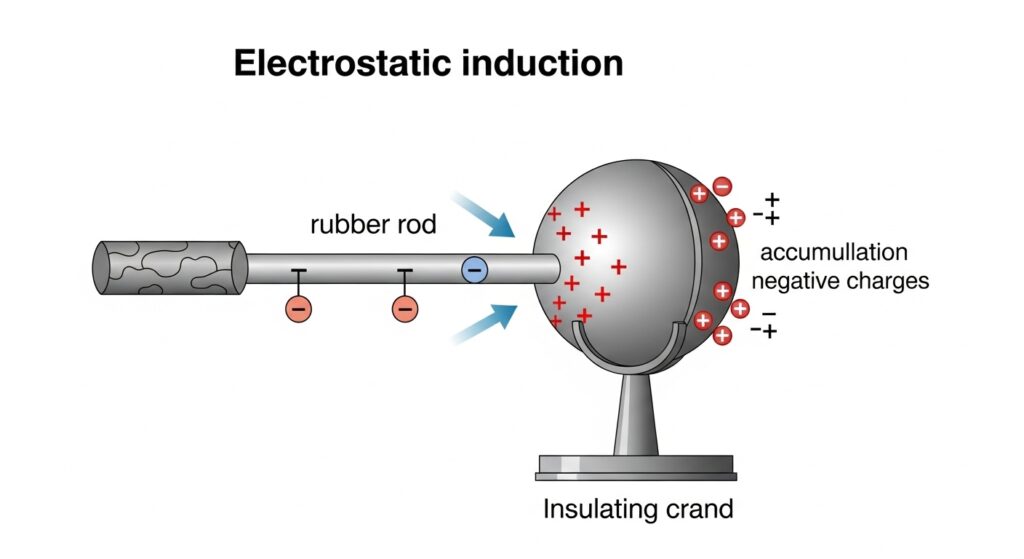
I have seen many students cramming this definition without understanding it. Let’s make it simple. If you bring a charged rod near a neutral body (without touching it), the charges inside the neutral body separate. Positive moves to one side, negative to the other. This phenomenon is called Electrostatic Induction.
3. Coulomb’s Law (The Most Important Formula)
This law is the heart of this chapter. You will likely see this as a Long Question in your board exams.
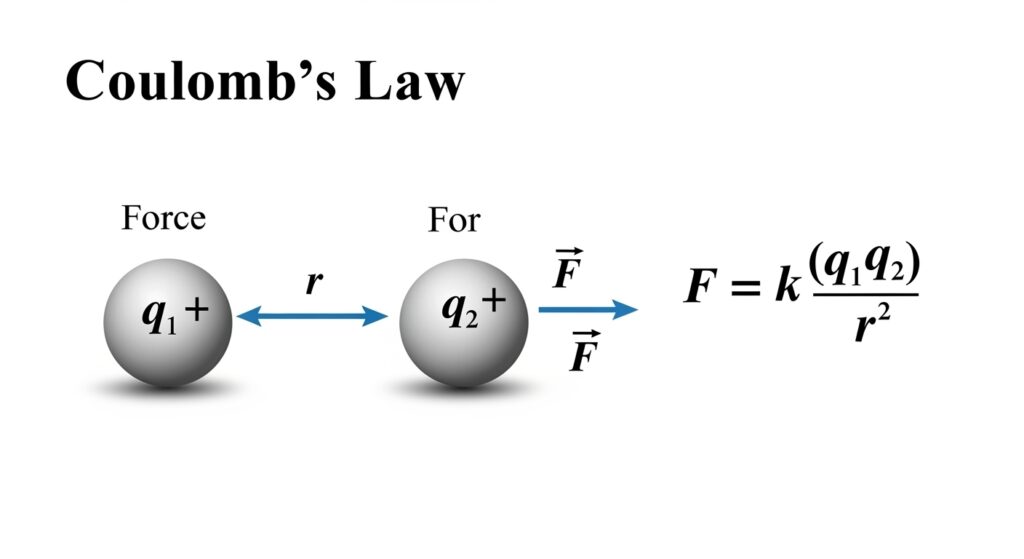
Charles Coulomb taught us how to measure the force between two charges.
The Formula:
$$F = k \frac{q_1 q_2}{r^2}$$
What does this mean?
- The bigger the charges ($q_1, q_2$), the stronger the force.
- The greater the distance ($r$) between them, the weaker the force becomes.
Exam Tip: When solving numericals, remember the value of ‘$k$’ for air is always $9 \times 10^9 Nm^2C^{-2}$.
4. Capacitors: The Energy Storehouse
Have you ever heard an electrician say, “The capacitor of this fan is weak” when the fan runs slowly?
A capacitor is a device used to store electric charge.
Formula:
$$Q = CV$$
(Where ‘C’ is Capacitance, and its unit is the Farad).
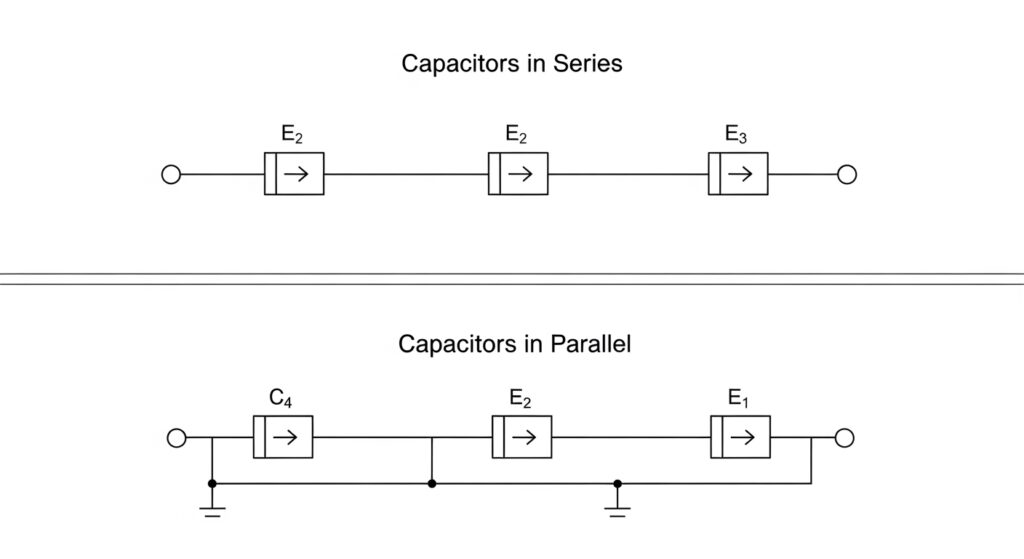
Connecting Capacitors (The Tricky Part):
This is where 90% of students make mistakes. The formulas for Capacitors are the OPPOSITE of Resistors.
- Parallel Combination: Voltage remains the same.
- Formula: $C_{eq} = C_1 + C_2 + C_3$ (Just add them up).
- Series Combination: Charge remains the same.
- Formula: $\frac{1}{C_{eq}} = \frac{1}{C_1} + \frac{1}{C_2} + \frac{1}{C_3}$ (Add their reciprocals).
5. Applications (Real-Life Uses)
Electrostatics isn’t just theory; it runs machines!
- Photocopier (Xerox Machine): It uses a drum coated with Selenium and static charges to stick black toner powder onto paper.
- Inkjet Printer: It charges tiny droplets of ink to guide them precisely onto the paper to form letters and images.
6. Dangers of Static Electricity (Lightning)
When clouds rub against air particles, they gather a massive amount of static charge. When this charge jumps to the ground, we call it Lightning.
To protect tall buildings, we use Lightning Conductors, which provide a safe path for the charge to flow into the earth without damaging the building.
Important Short Questions (2025 Syllabus)
Memorize these for Section B of your paper:
Q1: Define Capacitance and its unit.
Ans: The ability of a capacitor to store charge is called Capacitance.
Formula: $C = Q/V$.
Unit: Farad (F).
Q2: What is a Dielectric?
Ans: Any insulating material (like air, glass, or wood) placed between the plates of a capacitor is called a Dielectric. It increases the capacitance of the capacitor.
Q3: State Coulomb’s Law.
Ans: The force of attraction or repulsion between two point charges is directly proportional to the product of the magnitude of charges and inversely proportional to the square of the distance between them.
Chapter Summary (Quick Recap)
- Charge: Two types exist (Positive and Negative).
- Coulomb’s Law: Calculates electric force ($F = k q_1q_2/r^2$).
- Electric Field: The region around a charge where its influence is felt.
- Capacitor: Stores charge ($Q=CV$).
- Parallel Combination: Capacitance increases ($C_{eq} = C_1 + C_2$).
- Series Combination: Capacitance decreases.
FAQs: Students Also Ask
Q: Is 1 Farad a big unit?
Ans: Yes, 1 Farad is a huge unit! That is why in numerical problems, we always use smaller units like Micro-Farad ($\mu F$) or Pico-Farad ($pF$).
Q: What is the Gold Leaf Electroscope used for?
Ans: It is a sensitive instrument used to detect the presence of charge and determine the nature of the charge (Positive/Negative).
Q: Does a capacitor block DC current?
Ans: Yes! A capacitor allows AC (Alternating Current) to pass through but blocks DC (Direct Current) after it is fully charged.
Final Advice
My advice for this chapter: Practice the “Series and Parallel” numericals at least 5 times. Remember, for Capacitors, Parallel means Add and Series means Divide. Don’t mix this up with resistors!
I hope these notes help you master Electrostatics.
Do you need notes for Chapter 5 (Current Electricity)? Let me know in the comments below!