
Imagine you are watching a horror movie, but you turn off the volume. Does it still feel scary? Probably not. Sound plays a huge role in our lives, from listening to your favorite songs to hearing your teacher scold you in class (just kidding!).
But when it comes to Physics Chapter 2, many students get confused between Pitch and Loudness. I have seen students losing marks just because they wrote “Frequency” instead of “Amplitude”.
Don’t worry. In this guide, I will break down the “Science of Sound” into simple, easy-to-digest concepts. By the end of this post, you will be ready to ace this chapter in your board exams.
What is Sound? (The Basics)
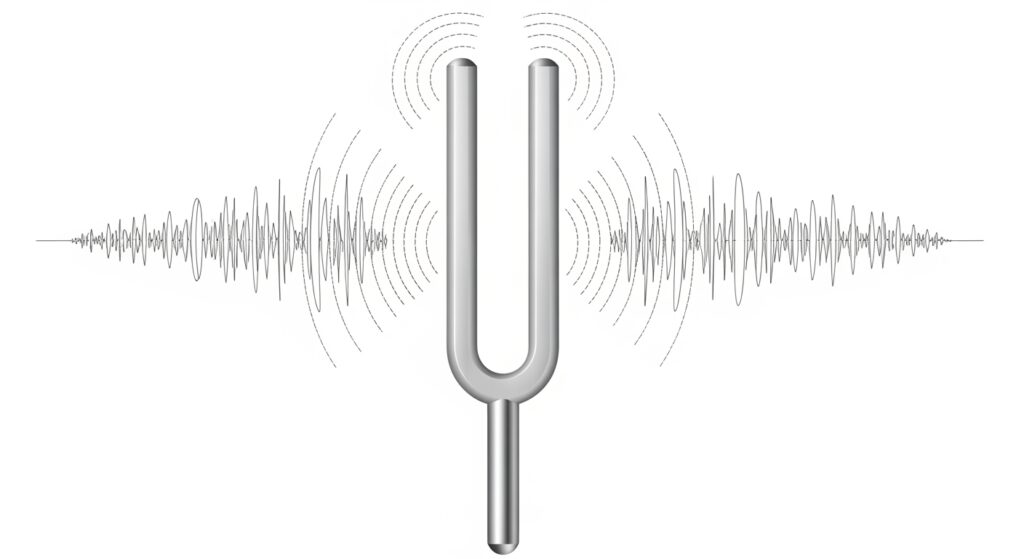
Sound is a form of energy that travels in the form of waves. But here is the catch: Sound is a “Social” wave—it needs friends (medium) to travel.
Unlike light, sound cannot travel through a vacuum. It needs air, water, or solids to move.
- How is it produced? Whenever a body vibrates, it produces sound.
- Example: Put your hand on your throat and say “Hello”. You will feel a vibration. That vibration is creating the sound.
Important for MCQs: Sound waves are Longitudinal Waves. This means particles move back and forth in the same direction as the wave (like a Slinky spring).
Characteristics of Sound (Most Important Topic)
If you look at past papers of the last 10 years, you will see this topic almost every time. Examiners love asking the difference between Loudness and Pitch. Let’s clear this up once and for all.
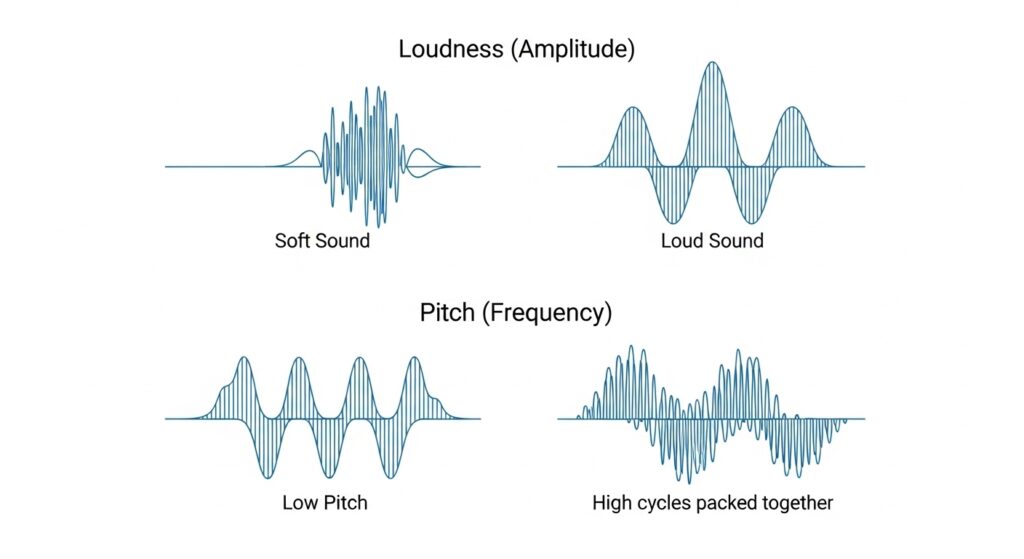
1. Loudness
Loudness tells us how “heavy” or “loud” a sound is.
- Depends on: Amplitude (The height of the wave).
- Real Life Example: If you beat a drum softly, the amplitude is low (faint sound). If you hit it hard, the amplitude is high (loud sound).
- Other factors: Area of the vibrating body (Large drum = Louder sound) and Distance from the source.
2. Pitch
Pitch tells us how “shrill” or “sharp” a sound is.
- Depends on: Frequency (How fast the wave vibrates).
- Real Life Example:
- Men’s Voice: Low Frequency = Low Pitch (Grave/Heavy voice).
- Women’s/Children’s Voice: High Frequency = High Pitch (Shrill voice).
3. Quality (Timbre)
Have you ever noticed that you can recognize your friend’s voice on the phone without seeing them? Or distinguish between a Piano and a Guitar even if they play the same note?
This is called Quality. It depends on the waveform of the sound.
Speed of Sound: Where Does it Travel Fastest?
Many students think sound travels fastest in the air because it is “light”. This is wrong!
I remember when I was in 10th grade, I marked “Gas” in an MCQ and lost 1 mark.
Here is the correct order:
Solids > Liquids > Gases
- Why? In solids (like steel or wood), particles are packed very closely. They pass the vibration to the next particle very quickly. In air, particles are far apart, so it takes longer.
- Formula for Speed:$$v = f \lambda$$(Where $v$ is speed, $f$ is frequency, and $\lambda$ is wavelength).
Real Life Example: The Echo Mystery
Let’s talk about something cool. Have you ever shouted your name in a mountain valley?
“Ali… Ali… Ali…”
It comes back! This is called Echo (Reflection of Sound).
But why doesn’t this happen in your small bedroom?
Here is the science: For an echo to be heard distinctively, the time gap between the original sound and the reflected sound must be at least 0.1 seconds.
In a small room, the wall is too close. The sound comes back so fast (less than 0.1s) that your brain mixes it with the original sound. In mountains, the distance is large (at least 17 meters), so you hear a clear echo.
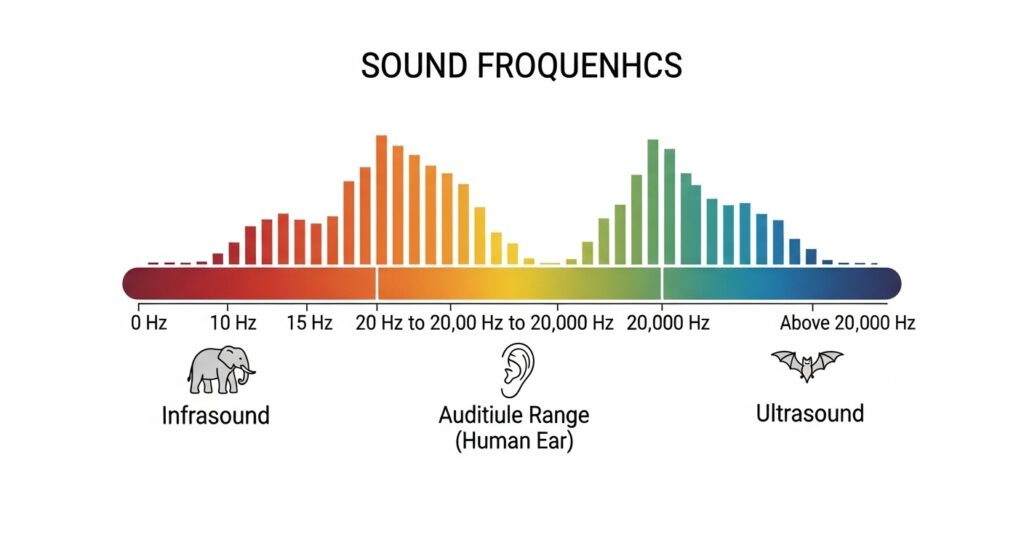
Audible Frequency Range
Our ears are amazing, but they have limits. A normal human ear can only hear sounds between:
20 Hz to 20,000 Hz
- Infrasound: Sound less than 20 Hz (Elephants communicate with this).
- Ultrasound: Sound more than 20,000 Hz (Bats use this to fly at night).
Important Short Questions (2025 Syllabus)
Here are the questions that are most likely to appear in your Section B (Short Answers).
Q1: Why sound cannot travel through a vacuum?
Ans: Sound waves are mechanical waves, which means they need a material medium (particles) to transfer energy. In a vacuum, there are no particles to vibrate, so sound cannot travel. (Reference: Bell Jar Experiment).
Q2: What is the difference between Musical Sound and Noise?
Ans:
- Musical Sound: Has a regular, smooth waveform and is pleasant to the ears (e.g., Flute, Violin).
- Noise: Has an irregular, sudden waveform and is unpleasant (e.g., Traffic, Slamming a door).
Q3: Calculate the frequency of a sound wave with speed 340 m/s and wavelength 0.5 m.
Ans:
- Formula: $v = f \lambda \Rightarrow f = v / \lambda$
- Calculation: $f = 340 / 0.5 = 680 Hz$.
Chapter Summary (Quick Revision)
- Sound is produced by vibrating bodies.
- Loudness depends on Amplitude, Area, and Distance.
- Pitch depends on Frequency.
- Echo is the reflection of sound (min distance 17m).
- Ultrasound is used in medical scans (Kidney stones) and SONAR.
FAQs: Students Also Ask
Here are some questions I often get in the comments section.
Q: Is “Intensity” the same as “Loudness”?
Ans: No! Intensity is a physical quantity (measurable energy), while Loudness is a physical sensation (how our ears perceive it). Intensity does not change from person to person, but Loudness does (a deaf person won’t hear a loud sound).
Q: Which numericals are important in Chapter 2?
Ans: Focus on the formula $S = vt$ (for Echo) and $v = f \lambda$. These two formulas cover 90% of the numericals.
Q: What is the speed of sound at room temperature?
Ans: It is approximately 343 m/s at 20°C. Remember, speed increases with temperature!
Final Words
Physics isn’t about memorizing definitions; it’s about understanding the “Why” and “How”. Next time you hear a guitar, try to think: “Is the amplitude high or the frequency?”
I hope these notes help you understand Sound better. I have tried to keep it simple and to the point.
If you have any confusion about the “Doppler Effect” or “Ultrasound uses”, drop a comment below. I will reply to you personally!