
Have you ever wondered how the Sun has been burning for billions of years without running out of fuel? Or why the word “Nuclear” scares people (think of the Atomic Bomb), yet it is used to treat cancer?
Welcome to the Grand Finale: Chapter 9 (Atomic & Nuclear Physics).
Let’s be honest—this chapter intimidates many students. The concepts of invisible rays and breaking atoms sound like science fiction. But here is the secret: This chapter is actually very short. If you understand just two things—Half-Life and Fission—you can easily score full marks.
In this guide, I will take you on a journey into the center of the atom. We will decode how to solve those tricky Half-Life numericals and understand the difference between Fission and Fusion.
1. The Atom & Isotopes (The Basics)
Before we talk about explosions, let’s look inside the Atom.
The center of an atom is called the Nucleus. It contains Protons (+) and Neutrons (Neutral).
What are Isotopes?
I have seen students memorize this definition and forget it the next day. Think of it like Siblings.
Isotopes are atoms of the same family (Same Element, Same Protons) but they have different weights (Different Neutrons).
- Example: Hydrogen has three siblings: Protium, Deuterium, and Tritium.
2. Natural Radioactivity (Invisible Bullets)
Some atoms are unstable. They want to become stable, so they throw out extra energy in the form of rays. This is called Radioactivity.
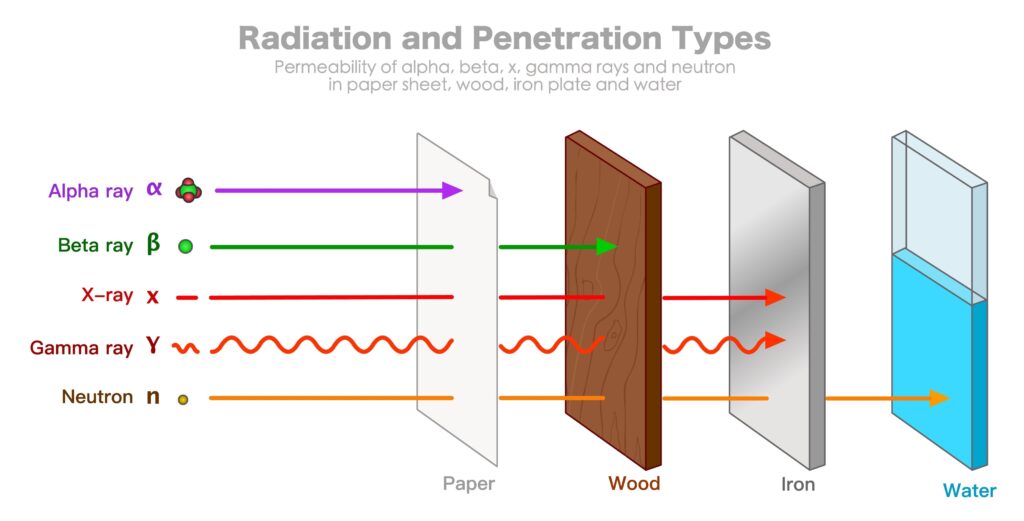
There are three types of “Invisible Bullets” (Rays):
- Alpha ($\alpha$): Heavy and slow. A piece of paper can stop it.
- Beta ($\beta$): Fast electrons. A wooden plank can stop it.
- Gamma ($\gamma$): Pure energy. Very dangerous. Only thick lead or concrete can stop it.
3. Half-Life (The Most Important Topic)
This is where 90% of students lose marks in numericals. Pay attention!
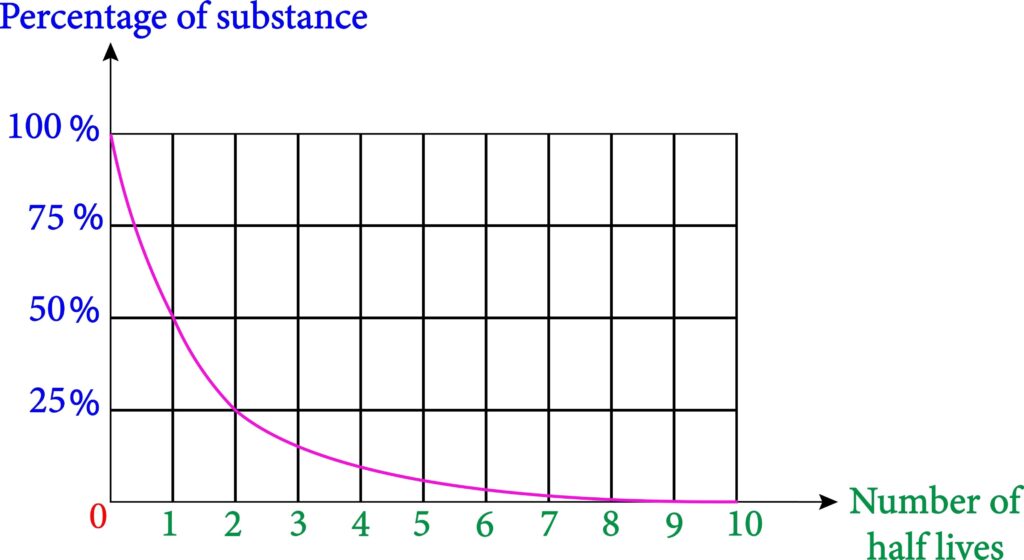
Half-Life is the time taken for half of the radioactive atoms to decay.
The Pizza Analogy:
Imagine you have a whole pizza.
- After 1 hour (1st Half-Life), you eat half. (50% left).
- After another hour (2nd Half-Life), you eat half of what was left. (25% left).
- After another hour, you eat half of that. (12.5% left).Notice? The pizza never completely vanishes; it just gets smaller and smaller. That is exactly how radioactive elements behave!
The Formula:
Remaining amount = Original Amount $\times (\frac{1}{2})^n$
(Where ‘n’ is the number of half-lives).
4. Nuclear Fission vs. Fusion (Breaking vs. Joining)
Students often mix these two up. Let’s clear the confusion.
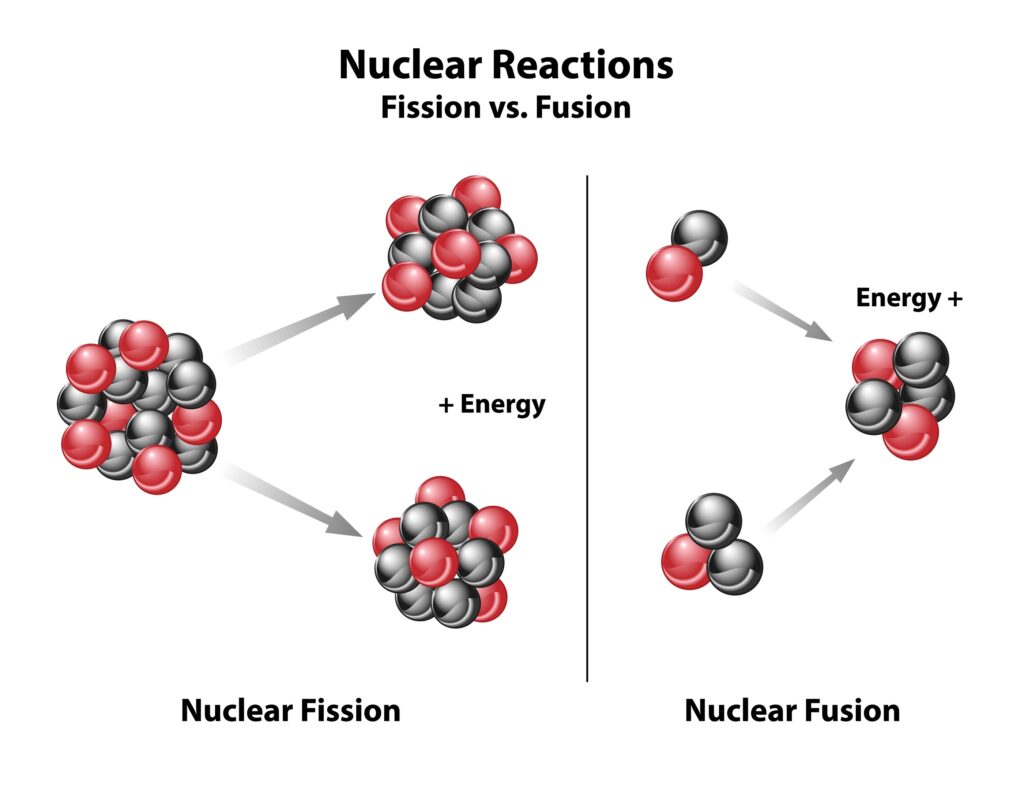
A. Nuclear Fission (The Breaker)
- Definition: Splitting a heavy nucleus (like Uranium) into two smaller nuclei.
- Result: A massive amount of energy is released.
- Real Life Example: This process is used in Nuclear Power Plants to generate electricity and in Atomic Bombs.
B. Nuclear Fusion (The Joiner)
- Definition: Joining two light nuclei (like Hydrogen) to form a heavier nucleus.
- Result: Even more energy is released than fission.
- Real Life Example: The Sun shines because of Fusion. It fuses Hydrogen into Helium every second.
5. Uses of Radioisotopes (Good Radiation)
Radiation isn’t always bad. We use it to save lives and solve mysteries.
- Carbon Dating: How do we know a dinosaur bone is 65 million years old? By measuring the Half-Life of Carbon-14 inside it.
- Medical Treatment: Cobalt-60 is used to kill cancer cells (Radiotherapy).
- Tracers: Doctors inject weak isotopes to trace blocks in arteries or kidneys.
6. Hazards & Safety (Stay Safe)
Radiation can cause skin burns and cancer. That is why safety is a priority.
- Always use Lead Aprons and Lead Boxes to store radioactive sources.
- Never handle sources with bare hands; use Tongs.
Important Short Questions (2025 Syllabus)
Q1: Define Half-Life.
Ans: The time required for half of the unstable radioactive nuclei to disintegrate (decay) is called Half-Life.
Q2: What is the difference between Background Radiation and Artificial Radiation?
Ans:
- Background: Natural radiation present everywhere (from rocks, soil, sun).
- Artificial: Man-made radiation (from X-rays, nuclear tests).
Q3: Write the reaction for Nuclear Fission.
Ans:
$$_{92}^{235}U + _{0}^{1}n \rightarrow _{56}^{141}Ba + _{36}^{92}Kr + 3_{0}^{1}n + Energy$$
(Make sure to practice writing this equation!).
Chapter Summary (Quick Recap)
- Isotopes: Same protons, different neutrons.
- Alpha/Beta/Gamma: Gamma is the most penetrating.
- Half-Life: Time to reduce to half ($1/2$).
- Fission: Splitting atom (Power Plants).
- Fusion: Joining atoms (Sun).
- Carbon Dating: Finding the age of old fossils.
FAQs: Students Also Ask
Q: Is Nuclear Fusion possible on Earth?
Ans: Scientists are trying, but it is very difficult because Fusion requires millions of degrees of temperature (like the Sun). Currently, we only use Fission for electricity.
Q: Which numerical is most important in Chapter 9?
Ans: The numericals where you have to find the “Remaining Amount” after a certain number of days are extremely important. Example: “If the half-life is 5 days, how much is left after 15 days?”
Q: Are X-Rays the same as Gamma Rays?
Ans: They are similar (both are waves), but their origin is different. Gamma rays come from the Nucleus, while X-rays come from Electron transitions.
Final Words & A Request
Congratulations! 🥳
You have successfully completed the Physics Class 10 Notes series. From Simple Harmonic Motion (Chapter 1) to Nuclear Physics (Chapter 9), we have covered everything.
My final advice: Physics is not about cramming; it’s about connecting. When you look at the sun, remember Fusion. When you charge your phone, remember Current.
Now, tell me in the comments: Should I start “Chemistry Class 10 Notes” next? Or do you want “Physics Guess Papers”?