
Do you also get confused with the plus (+) and minus (-) signs in numerical problems?
Let’s be honest—when I was in 10th grade, Chapter 3 (Geometrical Optics) used to scare me. I could never remember why a Convex Lens forms an inverted image or which mirror to use for shaving.
But here is the good news: This chapter is actually very logical. Once you understand the “Rules of the Game,” you can solve any question easily.
In this guide, I will explain Reflection, Refraction, and Lenses in the simplest way possible, without using boring textbook language. By the end of this article, you will be ready to ace your board exams.
1. Reflection of Light (The Mirror Magic)
Let’s start with something you do every morning—looking in the mirror.
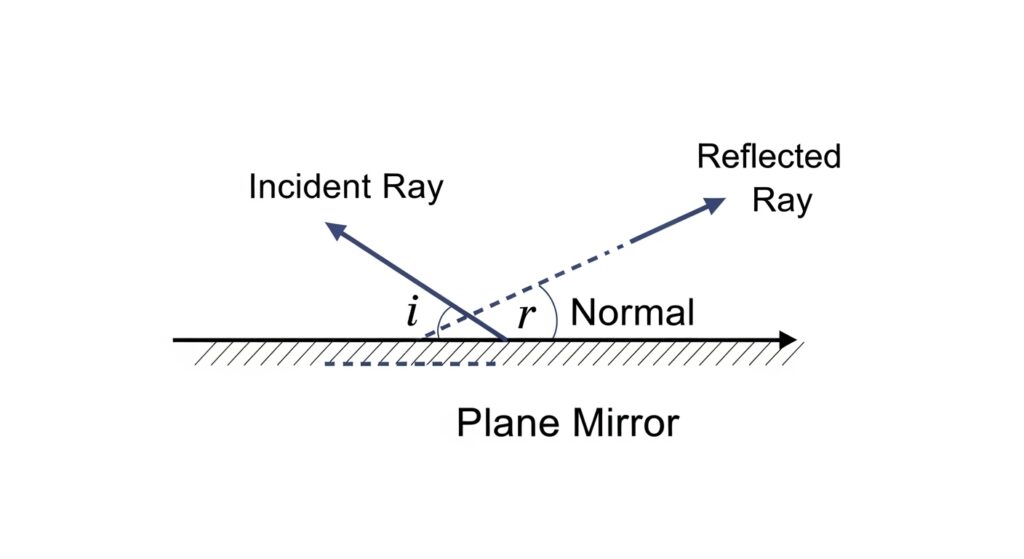
When light hits a shiny surface and bounces back, it is called Reflection of Light.
The Two Golden Rules (Laws of Reflection):
- The Incident ray, the Reflected ray, and the Normal all lie on the same plane.
- The Angle of Incidence ($i$) is always equal to the Angle of Reflection ($r$).
$$\angle i = \angle r$$
2. Spherical Mirrors: Concave vs. Convex
I have seen many students mixing up these two mirrors in the exam hall. Let me give you a trick to remember them forever.
- Concave Mirror: Focus on the word “Cave”. A cave goes inward. So, a mirror that curves inward is a Concave Mirror.
- Function: It collects light to a single point (Converging).
- Convex Mirror: This one bulges outward.
- Function: It spreads light out (Diverging).
Real-Life Example ( The Spoon Experiment):
Go to your kitchen and pick up a shiny steel spoon.
- Look at the inner side (where you put food): You will see your face upside down. That’s a Concave Mirror.
- Look at the back side: You will see your face upright and small. That’s a Convex Mirror.
3. Refraction of Light (Why Pencils Break?)
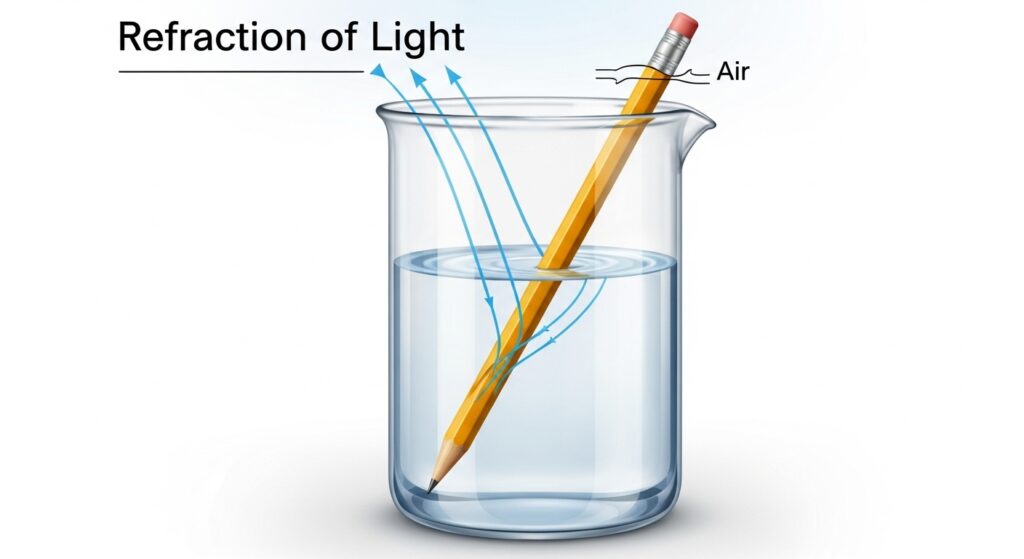
Have you ever placed a pencil in a glass of water? It looks broken or bent at the surface. Why?
This is not magic; it is Refraction.
When light travels from one medium (like Air) to another (like Water), it changes its speed and direction. This bending of light is called Refraction.
Snell’s Law (Memorize This Definition):
The ratio of the sine of the angle of incidence to the sine of the angle of refraction is constant.
$$n = \frac{\sin i}{\sin r}$$
(Where ‘n’ is the Refractive Index).
4. Total Internal Reflection & Optical Fibers
This is the most favorite topic of board examiners. Usually, light passes from glass to air. But if the angle is too steep (greater than the Critical Angle), the light doesn’t go out—it bounces back inside the glass! This is called Total Internal Reflection.
Where is it used? The high-speed Internet you use today works on Optical Fibers. These are thin glass threads where light travels by bouncing inside, carrying data at the speed of light.
Pro Tip: Remember that the critical angle for glass is 42°.
5. Lenses: The Game Changer
Mirrors reflect light, but Lenses let light pass through them.
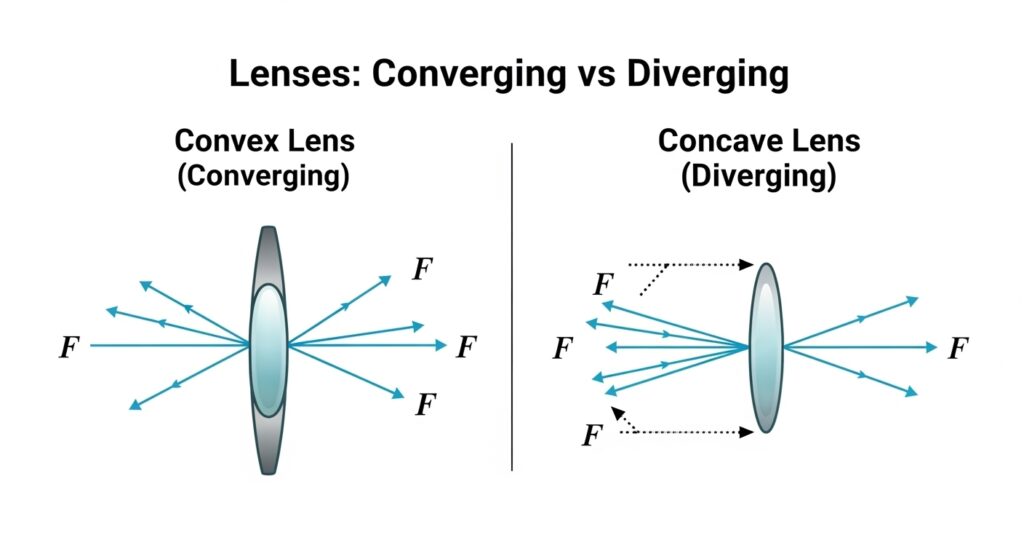
- Convex Lens (Converging): Thicker in the middle, thinner at the edges. (Used in magnifying glasses).
- Concave Lens (Diverging): Thinner in the middle, thicker at the edges.
6. The “Danger Zone”: Sign Convention & Numericals
Pay attention here! 90% of students fail numericals because they mess up the signs.
Save this table and memorize it:
| Quantity | Convex Lens | Concave Lens |
| Focal Length (f) | Positive (+) | Negative (-) |
| Object Distance (p) | Always Positive (+) | Always Positive (+) |
| Image Distance (q) | Positive (Real Image) | Negative (Virtual Image) |
The Lens Formula:
$$\frac{1}{f} = \frac{1}{p} + \frac{1}{q}$$
7. Defects of Vision (Why do we need glasses?)
Finally, let’s talk about the Human Eye.
- Short-Sightedness (Myopia): You can see near objects clearly, but distant objects are blurry.
- Correction: Use a Concave Lens.
- Long-Sightedness (Hypermetropia): You can see distant objects clearly, but reading a book is difficult.
- Correction: Use a Convex Lens.
Important Short Questions (2025 Syllabus)
Make sure to prepare these questions for Section B.
Q1: Define Power of Lens and its unit.
Ans: The reciprocal of focal length in meters is called the Power of a Lens.
Formula: $P = 1/f$ (where $f$ is in meters).
The unit is Dioptre (D).
Q2: What are the conditions for Total Internal Reflection?
Ans:
- The ray of light must travel from a denser medium to a rarer medium (e.g., Glass to Air).
- The angle of incidence must be greater than the critical angle.
Q3: Why are Convex mirrors used as side mirrors in cars?
Ans: Because a convex mirror always produces an upright and smaller image. This gives the driver a wider field of view of the traffic behind them.
Chapter Summary (Quick Recap)
- Reflection: Bouncing back of light.
- Refraction: Bending of light when changing medium.
- Convex Lens: Converges light (Focuses to a point).
- Concave Lens: Diverges light (Spreads it out).
- Formula: $1/f = 1/p + 1/q$.
FAQs: Students Also Ask
Q: Is the Mirror Formula different from the Lens Formula?
Ans: Good news! In Class 10 Physics, both the Mirror and Lens formulas are exactly the same: $1/f = 1/p + 1/q$. You just need to be careful with the signs (+ or -).
Q: Why does a prism form a rainbow?
Ans: This is called Dispersion. White light is made of 7 colors. When it passes through a prism, each color bends at a different angle, creating a spectrum (Rainbow).
Q: Which numericals are most important?
Ans: Focus on numericals involving a Convex Lens where the object is placed at $2F$ or between $F$ and the lens. These are frequently asked in exams.
Final Words
Physics isn’t just about memorizing definitions; it’s about visualizing how things work. My advice? Practice drawing the Ray Diagrams with a ruler and pencil. If your diagram is neat, the examiner will happily give you full marks.
I hope these notes made Geometrical Optics easier for you.
Do you need notes for Chapter 4 (Electrostatics)? Let me know in the comments below!