
Let’s be honest for a second—does the word “Physics” make you nervous? When I was in 10th grade, opening the first chapter and seeing terms like “Restoring Force” and scary diagrams used to panic me. I used to think, “Bas ratta laga leta hoon, pass ho jaunga.”
But here is the truth I learned later: Ratta (Cramming) fails you in board exams.
If you are struggling to understand Simple Harmonic Motion (SHM), you are in the right place. In this guide, I will explain Chapter 1 not like a boring textbook, but like a friend explaining it to you before the exam. By the end of this article, you will be able to solve any question from this chapter easily.
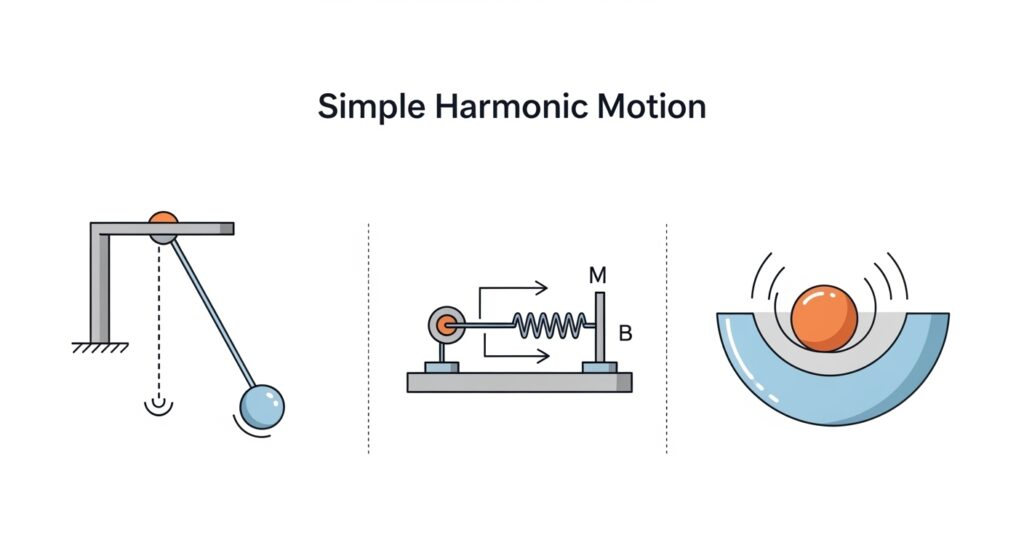
What is Simple Harmonic Motion? (In Simple Words)
Before we look at the complex definition, let’s talk about a playground swing (Jhoola).
Imagine you push a swing. What happens?
- It goes forward.
- It comes back to the center.
- It goes backward.
- It returns to the center again.
This “To-and-Fro” movement is called Oscillatory Motion.
Simple Harmonic Motion (SHM) is a special, disciplined type of this motion. In SHM, the object is like an obedient child—the farther you push it away from its home (mean position), the faster it wants to run back.
My Personal Tip: Whenever you see the term SHM, just remember this rule: “Acceleration is directly proportional to displacement, but in the opposite direction.”
The Formula:
$$a \propto -x$$
(The negative sign is the hero here—it tells us the force is always pulling the object back home).
3 Real-Life Examples (That You Must Write in Exams)
To get full marks in Federal or Punjab Board, you cannot just write definitions. You need to explain these examples clearly with diagrams.
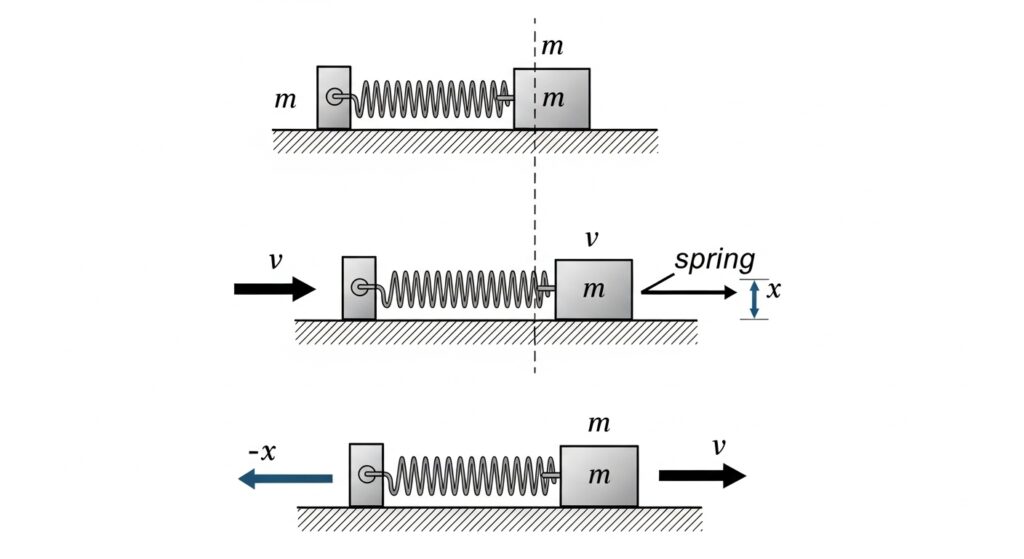
1. Motion of Mass Attached to a Spring
Imagine a spring fixed to a wall with a block attached to it.
- Rest Position (Mean Position): When you don’t touch it, the block is relaxed at position ‘O’.
- The Pull: When you pull the block to position ‘A’ and release it, the spring pulls it back. This pull is called the Restoring Force.
- The Mistake Students Make: Most students think the block stops at the center. It doesn’t! Due to Inertia (momentum), it rushes past the center to position ‘B’.
- The Result: It keeps moving back and forth. This is SHM.
2. The Ball and Bowl System
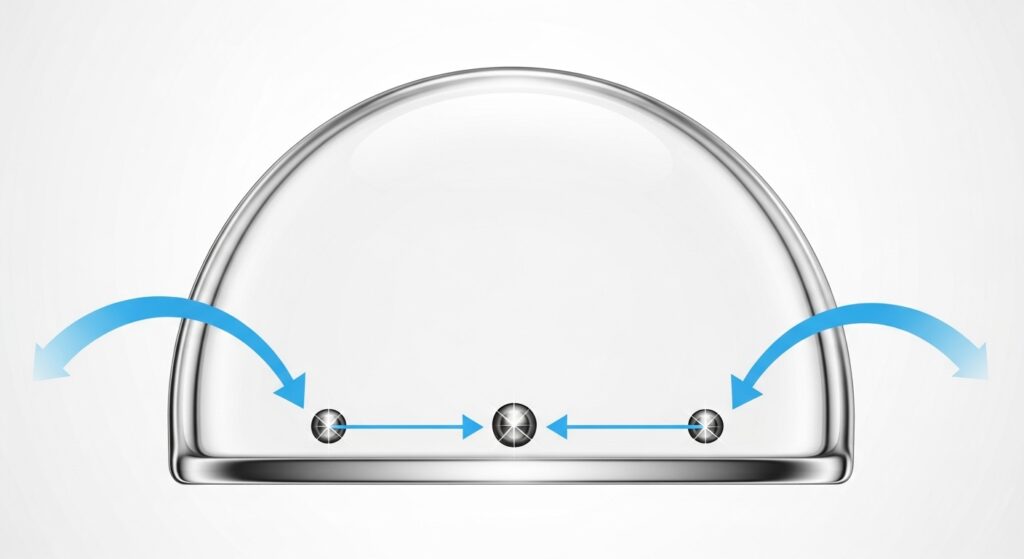
This is the easiest example to visualize.
- Take a bowl and place a marble inside.
- Gravity pulls it to the bottom (Mean Position).
- If you take the marble to the edge and drop it, gravity pulls it down.
- But again, does it stop at the bottom? No. It goes up the other side.
- Real Life Check: If the bowl is smooth, the ball will keep moving for a long time. If the surface is rough (friction), it will stop quickly.
3. A Simple Pendulum (The Most Important Topic)
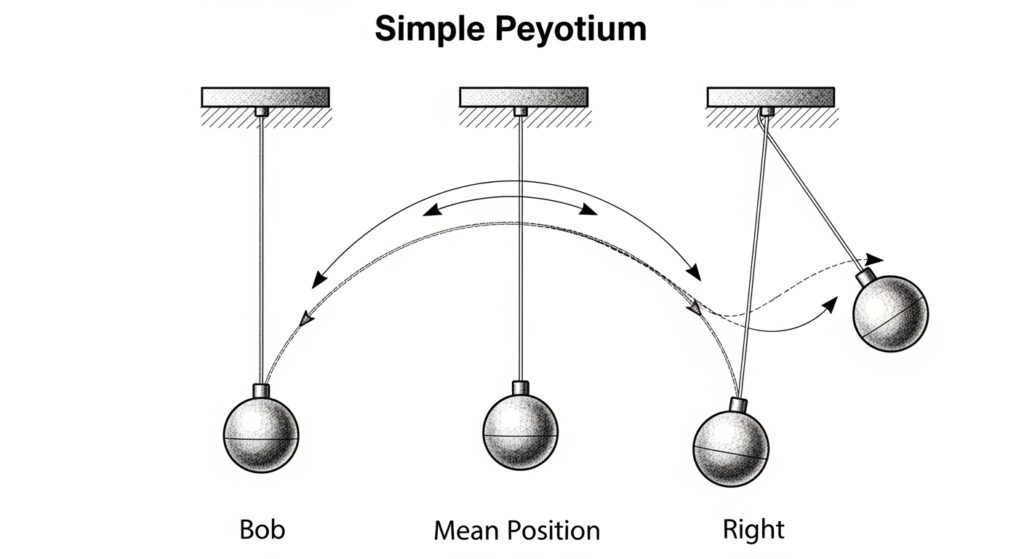
You have seen this in old grandfather clocks. A small ball (bob) hangs by a string.
When you disturb the bob, gravity acts as the restoring force.
Formula for Time Period:
$$T = 2\pi \sqrt{\frac{l}{g}}$$
Why is this formula important?
I have seen many students get confused in MCQs. Notice that there is no ‘m’ (mass) in this formula.
- Experiment: If you swing a heavy steel ball and a light plastic ball on the same string length, their time period will be the same. Mass does not matter!
Key Terms Summary (Quick Revision)
If you are running late for your exam, just memorize these 4 points. Examiners love asking these for 2 marks.
- Vibration: One complete trip (A → B → A).
- Time Period (T): How many seconds it takes for one vibration.
- Frequency (f): How many vibrations happen in one second. ($f = 1/T$)
- Amplitude: The maximum distance the body covers from the center.
“Why Do I Lose Marks?” (Common Student Mistakes)
As a mentor, I check hundreds of papers, and I see the same mistakes repeatedly. Avoid these to top your class:
- Forgetting Units: If you find Time Period ($T = 2$) but forget to write “seconds” ($2s$), you lose 0.5 marks immediately.
- No Diagrams: Physics is incomplete without diagrams. Even if the question doesn’t ask, draw a small pencil sketch of the pendulum.
- Mixing Definitions: Don’t confuse “Vibration” with “Frequency”. Vibration is a trip; Frequency is a number.
Important Short Questions (2025 Syllabus)
These are the “Hot Questions” for this year. Memorize them word-for-word.
Q1: What is Damped Oscillation? Give a practical application.
Ans: Oscillation in which the amplitude decreases over time due to friction/air resistance is called Damped Oscillation.
- Real Life Example: Shock Absorbers in Cars. They use damping to stop the car from bouncing continuously after hitting a bump.
Q2: If the length of a pendulum is made 4 times, what happens to the Time Period?
Ans: Using the formula $T \propto \sqrt{l}$.
If length becomes 4 times ($4l$), the square root of 4 is 2.
So, the Time Period will become double (2 times).
Q3: Define Restoring Force.
Ans: It is the force that pushes or pulls the oscillating object back towards its mean position. (e.g., Gravity in a pendulum, Elasticity in a spring).
FAQs: Students Also Ask
Here are some common questions students ask me about this chapter.
Q: Is this chapter important for Long Questions?
Ans: Yes! The “Simple Pendulum” and “Mass Spring System” are very popular Long Questions (5 Marks). Prepare them with diagrams.
Q: Can I skip the numericals?
Ans: I wouldn’t recommend it. The numericals in Chapter 1 are very short (mostly finding Time Period). They are “free marks.”
Q: How do I memorize the Wave Motion definitions?
Ans: Don’t memorize. Visualize a “Slinky Spring.” If you push it, it’s Longitudinal. If you jerk it up and down, it’s Transverse.
Final Words
Physics becomes easy when you connect it with daily life. Next time you sit on a swing or see a car go over a bump, remember: “That’s Simple Harmonic Motion!”
I hope these notes helped you clear your concepts.
Do you have any questions about this chapter? Or do you want notes for Chapter 2? Let me know in the comments below, and I will reply to you!